Simulate the New LSAT Format With Old PrepTests
You can build the new LSAT's shape from PrepTests you already own: one 52-minute Reading Comprehension block (6 passages), then 2 Logical Reasoning blocks of 32 questions in 45 minutes each, with a 10-minute break between each. It won't be exact, and the questions aren't new. But it gives you the real length and the real order months before LSAC's own new-format tests show up in February 2027.
Before you build anything, take the shortcut. Our free practice test in the August 2027 format is already laid out this way: RC first, then 2 LR sections, with 2 breaks. It's unofficial. Every question is scored, it saves as you go, and every question has an explanation. Honestly, don't burn 2 PrepTests on your first try. Take ours this week if you can, then use the recipe below for the rounds after that.
If you want the whole picture of what's changing, I wrote the full rundown of the August 2027 format change. This post only covers the how-to. If you're testing through June 2027, skip all of it. Your test keeps today's format.
Why bother simulating at all
LSAC's new-format practice tests land on LawHub in February 2027. Until then, you have PrepTests and a timer.
My read is that you don't need February to feel the length. You need a timer and 2 PrepTests. The skills don't change, and neither does the time per question, about 78 seconds for RC and about 84 for LR. What changes is how long you hold that pace without a reset. 6 passages in one sitting is 50% more reading than the 4 you do now, and the only way to learn how your focus holds is to sit through it.
The recipe: build a new-format test from 2 PrepTests
You need 2 PrepTests you haven't taken, or have honestly forgotten. Call them Test 1 and Test 2. You only need the RC and LR sections. If a test still has Logic Games, skip that section.
- Pick the 2 tests. Test 1 is the main one. Test 2 supplies the extra passages and questions. A test you remember won't tell you anything about your stamina.
- Build the RC block. Take the full RC section from Test 1 (4 passages, about 27 questions) and add 2 passages from Test 2's RC section (about 13 more). That's 6 passages on a single 52-minute timer, with no pause between the parts.
- Take a real break. 10 minutes, phone in another room. Get up and eat something. Don't replay the RC block in your head.
- Build LR block 1. Take a full LR section from Test 1 (25 or 26 questions) and add the first 6 or 7 questions of an LR section from Test 2. That's 32 questions on one 45-minute timer.
- Break again. Another 10 minutes. Same rules.
- Build LR block 2. Take Test 1's other LR section and add the last 6 or 7 questions from that same Test 2 section. Again, 32 questions in 45 minutes on one timer. Pulling one batch from the front and one from the back means neither block gets padded with only easy questions or only hard ones.
- Score all 104 as if they count. Mark every question right or wrong. Don't guess which ones would've been unscored, because you won't be able to on test day.
- Review by position. Split each block into thirds and count your misses in each. Note the passage number in RC and the stretch of 5 in LR. If your accuracy drops in the last 2 passages, or in the last 10 questions of an LR block, that's your fade, and it's a different problem from a weak question type.
Timing checks for each block:
- RC: a little under 9 minutes per passage (52 divided by 6 is about 8 minutes 40 seconds). Check the clock after each passage. If passage 2 took 11 minutes, you owe 2 back.
- LR: about 7 minutes per 5 questions. Check the clock at questions 5, 10, 15, 20, 25 and 30.
The whole thing runs 162 minutes with the breaks (52 + 10 + 45 + 10 + 45). Block out the afternoon.
My take on the order is to start cold with RC every time. No warm-up set, no easy LR to get going. On test day, passage 1 is the first thing you do all day, so practice that way. The order matters as much as the length.
Also, treat every question as scored. That's LSAC's advice for the real test, and your simulation should run the same way.
One note on scoring. A stitched-together test has no score conversion, so don't turn your results into a 120 to 180 number. Track percent right in each block and compare it to how you do on normal single sections. A drop in the second LR block is the thing you're looking for.
Test 2's leftovers (2 RC passages, one full LR section, and about half of the other) make good drill material. Don't burn your whole stack on this, though. Keep a few untouched PrepTests for after February.
What the simulation can't give you
I'd rather tell you the gaps than pretend the build is the real thing. 3 things are missing.
LSAC's actual unscored placement. On the real test, 2 of the 6 RC passages and 7 of each 32-question LR section won't count. LSAC hasn't said where they sit, and it says the positions vary by test taker. Nothing you stitch together from PrepTests can copy that, and I won't guess at it.
The real flow inside a 52-minute section. Your RC block is 2 PrepTest sections glued together at passage 4. The real section won't have a seam. LSAC also hasn't said whether each section still ramps in difficulty, so yours ramps the old way, twice.
The question-type balance LSAC will use. The question types stay the same. How many of each show up in a 32-question LR section, LSAC hasn't said, so yours is a mix of 2 old sections and nothing more.
So treat your build as a length-and-order rehearsal. Don't read your percent right as a score prediction, and don't build a theory about unscored questions from it.
How I'd use the months before February
Take our free test first. That tells you how 52 minutes of RC feels when it's the first thing you do. Then build one of your own every 2 to 3 weeks, and review each one fully before the next. A test with no review behind it just rehearses your mistakes.
When LSAC's tests arrive in February 2027, switch your full-length practice to those. LSAC hasn't said whether they're new questions or re-cut PrepTests, so I'll update this post when it does. If you're still figuring out the timeline, my August 2027 LSAT study plan lays out what to do in which month.
Frequently asked questions
Can I use old LSAT PrepTests to practice the new format?
Yes, for length and order. Combine 2 PrepTests into one 52-minute RC block and 2 LR blocks of 32 questions in 45 minutes each, with 10-minute breaks. The questions aren't new, and you can't copy LSAC's unscored placement.
When do new-format LSAT practice tests come out?
LSAC says February 2027, on LawHub. LSAC hasn't said whether they're new questions or re-cut PrepTests.
How do I time the new LSAT sections with old PrepTests?
Set one timer per block: 52 minutes for 6 RC passages, 45 minutes for each 32-question LR block. That's about 8 minutes 40 seconds per passage and about 7 minutes per 5 LR questions. Don't pause the clock between the PrepTest parts.
Do I need 2 PrepTests for one simulated new-format test?
Yes. A single PrepTest has 4 RC passages and 2 LR sections of about 25 questions each, so you borrow 2 passages and 6 or 7 questions per LR block from a second test.
Is there a free practice test in the new LSAT format?
Yes. Our free practice test in the August 2027 format runs RC first, then 2 LR sections, with 2 breaks. It's unofficial, every question is scored, and it saves as you go.
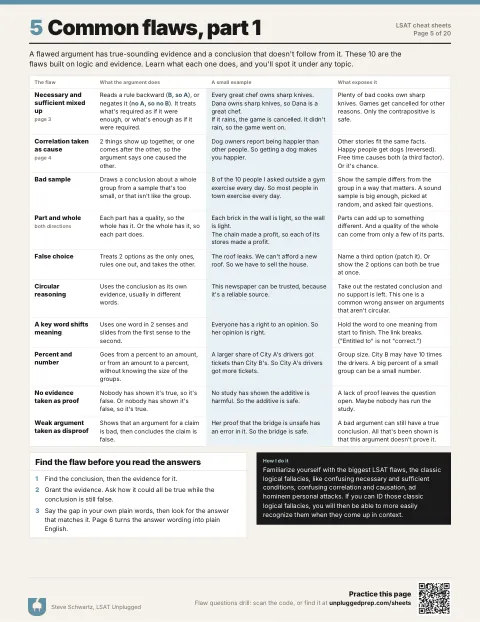
For the short list of what to study in either format, grab my free LSAT cheat sheet.
I've written free explanations for every question in LSAT PrepTest 159, 158, 157, 156, 155 and 154, with the right answer and why each wrong answer fails. All LSAT explanations are here.
Enough reading. Try a question. Free LSAT drills, 1 at a time, explained the second you answer. Start free drills