New LSAT Logical Reasoning: 32 Questions in 45 Minutes
From the August 2027 test, each Logical Reasoning section runs 45 minutes with 32 questions (25 scored, 7 unscored), and you take 2 of them with a 10-minute break in between. That's about 84 seconds a question, the same per-question pace as today. The section is just 10 minutes and about 7 questions longer.
Holding 84 seconds a question through 90 minutes of LR, after a long Reading Comprehension section, is where people leak points. If you want the rest of the change, the full rundown of the August 2027 format change covers it. Every test through June 2027 keeps today's format, so if that's you, none of this applies yet. This post is only about the LR clock.
The checkpoint clock for 32 questions in 45 minutes
Here's the on-pace time at each checkpoint, at 84 seconds a question:
| After question | On-pace time elapsed | Time left |
|---|---|---|
| 5 | 7:00 | 38:00 |
| 10 | 14:00 | 31:00 |
| 15 | 21:00 | 24:00 |
| 20 | 28:00 | 17:00 |
| 25 | 35:00 | 10:00 |
| 30 | 42:00 | 3:00 |
| 32 | 45:00 | 0:00 |
Check the clock at those 7 spots, and don't check it after every question. If you're 90 seconds behind at question 10, you know to speed up before it costs you anything. If you're 90 seconds ahead, you just earned time to spend on a hard one. Memorize the table in practice so you don't spend any brain on it on test day.
Looking at the clock after every question is a bad habit. It breaks your reading and teaches you to rush the easy ones. Every 5 questions is plenty.
Of course, this table assumes every question takes the same time. They don't, which is why you need the 2 rules below.
Rule 1: the 2-minute ceiling
When a question hits 2 minutes, you stop. Pick your best answer, flag it, and go to the next question. If time remains at the end, you come back.
The number is 2 because your average is 84 seconds. A question that runs to 2 minutes costs you 36 extra seconds, which you can afford now and then. One that runs to 3 minutes costs 96.
My read: most people's LR time problem isn't slow reading across the board. It's 3 or 4 questions that eat 3 minutes each. Here's a made-up example. Say 4 questions in a section take you 3 minutes apiece. That's 12 minutes. At your normal pace those 4 would take 5 minutes 36 seconds, so you just burned about 6 and a half minutes. That's enough time for roughly 4 more questions, and you'll probably end up guessing on the last few anyway.
The ceiling fixes most of that. A question that's gone past 2 minutes usually isn't about to click. You're rereading the stimulus and talking yourself in circles. Come back with the other questions behind you, and the answer often shows up fast.
Rule 2: never leave a blank
There's no penalty for wrong answers on the LSAT. So every question gets a bubble, always.
Reserve the last 30 seconds of each section for this. At 44:30, stop thinking and start bubbling. Pick the best answer left on each flagged question you didn't get back to, even if all you've done is cross out 2 choices. A blank scores 0 every time, and a guess at least has a shot.
This pairs with the ceiling. You flag fast and keep your pace, and you never walk out of a section with an empty bubble.
The 7 unscored questions in each section
7 of the 32 questions in each section don't count, and LSAC won't tell you which ones. LSAC also hasn't said where in the section they sit. Its advice is to treat every question as scored, and I'd follow that exactly.
My read: you'll see a few questions that feel off, maybe odd wording or a stimulus that doesn't quite fit. Play them straight. LSAC says the unscored questions are balanced in type and difficulty with the scored ones, so "this feels strange" doesn't tell you it's free. And don't change how you attack question types for the new format. A Flaw question is a Flaw question.
Logical Reasoning is still 2/3 of your score, 50 of the 77 scored questions. This is where the points are, so it's worth getting the clock right.
The second Logical Reasoning section is where the fade shows up
Section 3 starts 117 minutes into the test if you count the breaks. By then you've done 52 minutes of Reading Comprehension and 45 minutes of Logical Reasoning, and you're about to do another 45.
The fade shows up in the last 8 to 10 questions of that section, roughly 23 to 32. That's my read from coaching, not an LSAC number. LSAC hasn't said whether a section still ramps in difficulty, so I'm not claiming the late questions are tougher, only that you're more tired when you reach them. You still know the Flaw questions. You just stop rereading the answer choices and start picking the one that looks fine, and it feels quick while it's happening.
You can measure it. After every full practice test, log your misses by position, for both LR sections. Write down the question number, not just the count.
Then compare section 2 to section 3.
- Misses bunch up in questions 23 to 32 of section 3 and not in section 2. That's the fade.
- The same misses sit in the same spots in both sections. That's a skill gap, since a weak spot with Parallel Reasoning shows up in both, and you fix it the way you always did, with review.
- Section 2 is the weak one. Your warm-up or your pacing is off, so check your first 5 checkpoints.
If you find the fade, 2 fixes:
- Hold the checkpoint clock tighter in section 3. Same 7 checkpoints, same 2-minute ceiling, no coasting.
- Use the break. Stand up, eat something, and keep section 2 out of your head. Replaying a bad question from the first LR section costs you time in the second.
Honestly, you won't know how your own fade looks until you've sat through the whole thing. Our free practice test in the August 2027 format has the 2 LR sections at 45 minutes, back to back with the break. It's unofficial, every question is scored, it saves as you go, and every question has an explanation.
Frequently asked questions
How many Logical Reasoning questions are on the new LSAT?
64 across 2 sections, 32 in each. 50 of them are scored, 25 per section, and the other 14 are unscored.
How long is each Logical Reasoning section on the new LSAT?
45 minutes. That's about 84 seconds a question, the same average LSAC uses today.
Is there a penalty for guessing on the LSAT?
No. A wrong answer costs the same as a blank, so answer every question.
How many LR questions are unscored?
7 in each Logical Reasoning section, so 14 in all. LSAC won't say which ones, even after you get your score, and it advises treating every question as scored.
Is Logical Reasoning still 2/3 of the LSAT score?
Yes. LR is 50 of your 77 scored questions, and Reading Comprehension is the other 27.
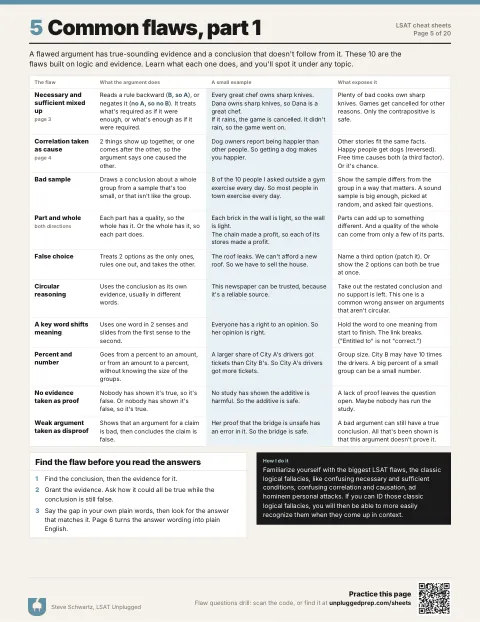
If you want the short list of what to work on for either format, my free LSAT cheat sheet has it.
I've written free explanations for every question in LSAT PrepTest 159, 158, 157, 156, 155 and 154, with the right answer and why each wrong answer fails. All LSAT explanations are here.
Enough reading. Try a question. Free LSAT drills, 1 at a time, explained the second you answer. Start free drills