
LSAT Graph / Spreadsheet: How Many Questions to Score 170 / 160
On the old 100-question LSAT, you could miss 11 to 13 questions and still score 170, or about 25 and still hit 160, and that cushion shrank over the years. Today's test has 2 scored Logical Reasoning sections and 1 scored Reading Comprehension section, roughly 75 to 77 questions, so the raw counts drop but the percentage you need holds.
Today's LSAT: April 2025 conversion table, 77 scored questions
| Score | Questions right | Questions missed |
|---|---|---|
| 170 | 69 | 8 |
| 165 | 63 | 14 |
| 160 | 56 | 21 |
Every test has its own table, so expect these to move by a question or 2. For every score from 120 to 180, see the full LSAT raw score conversion chart.
After I compile a lot of data, I like to analyze it.
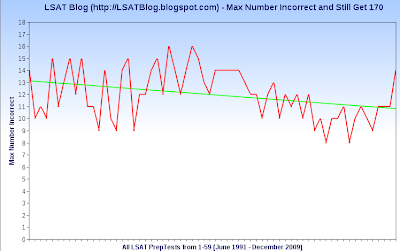
When I wrote the article on Raw Score Conversion Charts for LSAT PrepTests, I decided to create a graph illustrating the maximum number of questions you can miss on every LSAT PrepTest and still get a 170. (I also made one about getting a 160 – scroll to the end for info about that one)
(Click image to enlarge, and see details and analysis below.)
Details
This graph covers released LSAT PrepTests 1 – PrepTest 59. It includes the SuperPrep exams, the Feb 97 LSAT, and the June 07 LSAT (PDF), and it places all exams in chronological order from left-to-right on the x-axis.
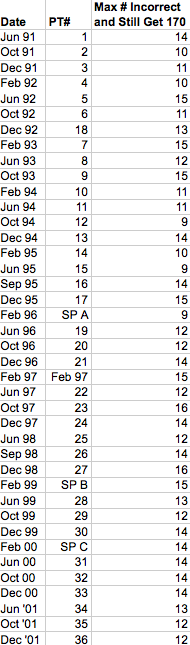
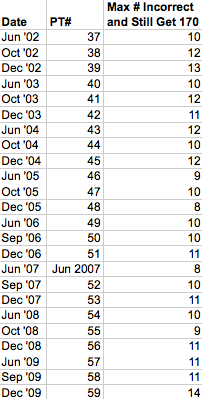
(In the data lists below, “SP” stands for SuperPrep, Official (Feb 97) is the Official LSAT PrepTest with Explanations, and Free (June 07) PrepTest on LSAC’s website.)
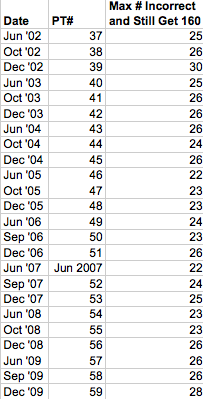
There wasn’t enough space to include the data for the x-axis (the horizontal line) on the graph itself. However, I’ve uploaded the data as 2 separate images below (click images to enlarge) so you can see the # of questions you can miss and still get a 170 for specific PrepTests.
You might wonder why I look at the number of questions you can get wrong and still get a 170. Why don’t I look at the number of questions you need to get right?
Because not all exams have the same number of questions. The # of questions of exams has ranged from 99 to 102. For this reason, it makes sense to look at the difference between the number of questions required for a 170 score and the total number of questions on a given exam.
Data Images
(Click images to enlarge.)
PrepTests 1-36:
 PrepTests 37-59:
Analysis
As you can see, there’s been a significant downward trend in the number of questions you can get wrong and still get 170. That green line on the graph illustrates this decreasing average.
Basically, you can’t miss as many questions today as you used to and still get a 170. The average has moved from -13 (13 incorrect) to -11. A change of 2 raw score points (getting 2 fewer questions wrong) might not seem very significant, but it’s significant when the historical range is only 8-16.
The cushy days of getting 15 or 16 questions incorrect but still walking away with a 170 score are long gone.
What does this all mean for you?
I only posted this graph and data to satisfy your curiosity and give you a sense of the trend.
In short, the raw score conversion charts of older exams don’t adequately represent those of more recent exams. There’s been a shift. You’ll need to get more questions right than you would’ve in the past in order to get a 170.
The bottom line
Your goal should be the same as its always been – get as many questions correct as possible.
I made a similar graph depicting how many questions you can get wrong and still get a 160. As you might expect, there’s a downward trend for that one also.
(Click image to enlarge.)
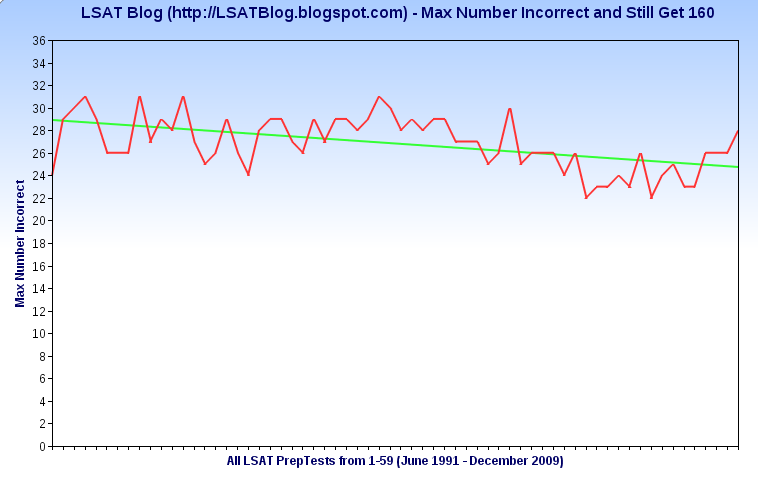
The range for this graph is 22-31 questions incorrect, with the -31 occurring some time ago and the -22 being much more recent. The average # of questions you can get wrong and still get a 160 has dropped from 29 to 25.
My analysis for this is pretty much the same as for the 170 graph.
Data Images
(Click images to enlarge.)
PrepTests 1-36:
 PrepTests 37-59:
Frequently asked questions
How many questions can I miss on the LSAT and still get a 170?
On PrepTests 1 through 59 (about 100 questions each), the average was 11 wrong, down from 13 on the earliest tests, with a range of 8 to 16. Scaled to today's 75-to-77-question test, that's roughly 8 or 9 wrong.
How many questions can I miss and still get a 160?
On the older format, about 25 wrong on average, down from 29 on the earliest tests, with a range of 22 to 31. That's roughly 75% correct, and the percentage is what carries over to the current test.
Has the number of questions you can miss for a 170 changed over time?
Yes. Across PrepTests 1 to 59 the average for a 170 dropped from 13 wrong to 11 wrong. 2 questions sounds small until you're the one sitting at 168. Part of why: the experimental section is how LSAC calibrates difficulty.
Do these numbers apply to the current LSAT?
Not as raw counts. The current test has about 75 to 77 scored questions instead of 100 and no Logic Games, so use the percentages. Every LSAC score conversion is set per test, so the exact cutoff moves a point or 2 either way.
I've written free explanations for every question in LSAT PrepTest 159, 158, 157, 156, 155 and 154, with the right answer and why each wrong answer fails. All LSAT explanations are here.
Enough reading. Try a question. Free LSAT drills, 1 at a time, explained the second you answer. Start free drills
