Mini Logic Games in LSAT Logical Reasoning: All 128 Listed
Mini logic games are Logical Reasoning questions that hand you 3 or more linked rules and ask what has to follow. Logic Games left the LSAT starting with the August 2024 test, but this skill stayed behind inside LR. On released PrepTests you'll see about 1 per test, and takers report more of them on live tests.
The rest of this page teaches you how to beat them, then gives you every one I found on 102 released tests.
What a mini logic game looks like
You're late in an LR section. There's no argument to judge. There's just a stack of rules and a stem that says must be true. One r/LSAT poster put it well in June 2025: "I can grasp the sentences separately, but never together."
I read about 200 r/LSAT posts and comments since June 2023 that use the term. They describe 2 kinds.
- Rules about named things. People, items, or places, often sorted into groups or slots, with if-then rules on top. This kind feels most like a game. Takers describe it on tests from November 2025 through September 2026.
- A chain of statements. If-then rules, or all, some, most, and none claims, with no setup at all. You get 3 to 5 of them and have to stack them. 2 released ones people name a lot are the large zoos question (PT 159 S1 Q22, which some call S3) and the parrot question (PT 116 S2 Q22).
The stem is usually must be true or "properly inferred." Sometimes it's could be true, must be false, or EXCEPT.
The good news is you already own the practice material. Any must be true question on a released PrepTest with 3 or more linked rules trains this exact skill.
Each single step is easy. The hard part is holding 3 to 5 of them in order. And every miss I see happens in the gaps between steps.
Personally, I think the bigger issue is who's taking the test now. Most people studying today never studied games at all. They never built the habit of holding several rules at once.
The 3 mistakes that cost you the point
I've watched a lot of students work these out loud. Their misses land in 3 buckets. You'll see all 3 on regular LR questions too. The extra rules just give each one more room to hurt you.
Mistake 1: you read every rule in order
You read rule 1 and hold it. Then you add rule 2 and hold both. By rule 4, rule 1 is gone. This is the "I can grasp the sentences separately" problem.
Most of these have one anchor. It's a rule or a fact that touches more than one thing. Start there. Bring in the other rules only when your chain reaches them. Some rules never come up at all, and that's fine.
Mistake 2: you stop at the first link
Say A gets you B, and B gets you C. You find A to B, and it feels like a win. So you look at the answers.
The test plans for that. There's often an answer that sounds like your first link but claims a bit more. Push the chain all the way to the end before you look down. If nothing matches your last inference exactly, you're probably a link or 2 short.
On a long chain, sketch it. Use arrows for if-then and a ladder for anything ranked. Give it 20 seconds, tops.
Mistake 3: you pick could be true when the stem says must
Honestly, this is the one I'd fix first. It's the miss I see most. The wrong answer sits right beside your last inference, and it fits every rule you remember. An answer can fit them all and still be false in some world.
So test answers with a made-up world. It can be silly. It only has to obey every rule.
- Must be true: try to build one world where every rule holds and the answer is false. If you can, cross it off.
- Could be true: one world where the answer holds keeps it alive.
- Must be false: pick the answer no world allows.
- Most strongly supported: pick the answer that needs the fewest extra facts.
The chain rules mini logic games test
You need a short list of rules cold. If any of these feel shaky, my page on if-then, only if, and unless walks through them slowly.
- "If A, then B" also gives you "if not B, then not A." It tells you nothing when A is false.
- "A only if B" means if A, then B.
- "A unless B" means if not B, then A.
- "All A are B" plus "some C are A" gets you "some C are B."
- 2 "some" statements give you nothing. "Most" plus "some" gives you nothing either.
- "Most A are B" plus "most A are C" gets you "some B are C." Some A have to be both.
The quantity words trip people up most. Here's my breakdown of all, most, some, and none on the LSAT if you want more reps.
Try one: the Halvern Press question
I wrote this one for practice. It's not an LSAC question, because of copyright. It's on the harder side, and it sets up all 3 mistakes. Watch where you stop.
Every atlas that Halvern Press has ever published runs to more than 600 pages, whereas none of Halvern's novels reaches 600 pages. On Halvern's list, the titles that came out before 2010 outnumber the rest. Odlum Press brought out its first book only after 2010, and its atlases and novels all come in under 600 pages. The glass display case at Tessaly Books holds only titles from these two presses, and its shelves cannot hold any book of 600 pages or more. An atlas called Rivers of the Karst Coast now sits in that case.
If the statements above are true, which one of the following must also be true?
(A) No Halvern Press title is currently on display in the case at Tessaly Books.
(B) Whichever Halvern title is the newest, it still predates the earliest title that Odlum Press issued.
(C) Halvern Press is the publisher of Rivers of the Karst Coast.
(D) The display case at Tessaly Books contains atlases and nothing else.
(E) The press that publishes Rivers of the Karst Coast brought it out after 2010.
Try it in 90 seconds. The answer is below.
The walkthrough
Most people start with Halvern, then Odlum, top to bottom. That's mistake 1. You've chewed through 4 sentences of rules before you reach the one fact about an actual book.
Start with that fact instead. The atlas sits in the case. The case rule is your anchor, because it limits 2 things at once. Anything in it runs under 600 pages, and it comes from Halvern or Odlum.
Now build the chain. In the case means under 600 pages. Every Halvern atlas runs over 600. So this atlas isn't from Halvern.
This is where most people quit, which is mistake 2. You just found "not Halvern," so your eyes hunt for it. (A) looks like it. But (A) says no Halvern title at all is in the case. You only ruled out Halvern atlases. Halvern novels never came up, and they all run under 600 pages.
Choose (A) and you've stacked mistake 3 on top. It could be true. Nothing forces it. Drop a 300-page Halvern novel into the case beside the atlas. Every rule still holds, and (A) is false. That same novel sinks (D), since the case no longer holds only atlases.
So finish the chain. The case only holds books from these 2 presses. Not Halvern means Odlum. Odlum's first book came out after 2010, so every Odlum book did, and that includes this atlas. The answer is (E), 2 links past "not Halvern."
The last 2 are quicker. (B) reads "most" as "all." Halvern's list is mostly older titles, but one could be newer than Odlum's first book. (C) names the press you already ruled out.
This one runs 95 words on purpose, to push you. The released ones on my list average closer to 60.
A 2-night drill for mini logic games
All you need is 2 released questions and a pen.
- Tonight, do PT 124 S3 Q19 (Lind, Knight, Jones) untimed.
- Before you check the answer, write 3 lines. Line 1 is the first rule you used. Line 2 is where 2 rules connected. Line 3 is the made-up world you tested on the answer you chose.
- Tomorrow, do the zoo question (PT 159 S1 Q22) in 90 seconds. Write the same 3 lines.
Then read what you wrote.
- If line 1 wasn't the anchor, you read every rule in order.
- If line 2 ends at your first inference, you quit early.
- If line 3 is blank, you never checked whether the rules forced your pick.
If the same line breaks both nights, that's your drill. For more reps on rule-heavy LR, try my free LSAT drills.
How often mini logic games show up
On released tests, it's about 1 per test. On live tests, takers report more. The gap between those 2 has a simple cause.
What the released tests show
I sorted every LR question on 102 released tests. That's 201 LR sections, from 1991 to April 2025. It covers every LawHub PrepTest (101 to 159), plus older tests like PT 1 to 23 and PrepTest A.
- 128 of 5,000+ LR questions fit. That's 2.5%, or about 1.3 per test.
- 20 tests have none, and 47 have exactly 1.
- The most on one test is 4, on old PT 41 and PT 43.
- No single section I have holds more than 2.
- They cluster late. 67 of the 128 sit at question 18 or later, where only about a third of all questions sit.
- The strict kind, named items with rules on top, is rare. I found 21, about 1 every 5 tests.
To make my list, a question needed 3 or more linked formal-logic statements, or a rule set about named items. Where you draw that line changes the count, so treat 128 as close, not exact.
Why your PrepTests can't show the rise
On released tests, the rate stays about flat from 1991 on. So there's no rise on released tests. That's because released content is old by the time you see it.
- PT 91 to 94 came out in the 2020s. Takers report those were first given from 2009 to 2013.
- The released April 2025 test reuses LR sections first given in 2014 and 2016, per test-day recaps.
- LSAC tries questions out unscored first, and it reuses whole sections later.
What takers report on live tests
For the tests people sit for now, takers are the only signal. I searched r/LSAT test-day threads back to 2012.
- June 2023 to August 2024: the talk starts, a year before games left. Much of it is about the experimental LR section.
- Since August 2024: reports show up on nearly every test.
- January 2026: the outlier. A 63-upvote r/LSAT post said one LR section had 5 or 6. A 58-upvote comment said all of LR felt that way. LSAC hasn't released anything from 2026, so nobody can check it.
- September and October 2026: the reports keep coming.
Some of those reports come from the experimental section. But some count for sure. In January 2026, one taker had 2 RC sections and still hit them, so both LR sections were scored.
Look, I can't prove the rate went up. Takers report more on live tests, and released tests show no rise because their content is years old. Personally, I'd prep as if you'll see more than 1. And LR is 2 of 3 scored sections. Ignore these and you're leaving points on the biggest part of the test.
EXCEPT stems
About a dozen on my list use EXCEPT. 2 good ones are PT 108 S3 Q18 (Chelas and Stelma) and PT 145 S2 Q25 (seals and dolphins). That second one is a ranking question that didn't make my list, but it's great practice.
EXCEPT flips the made-up world.
- Could be true EXCEPT: 4 answers could be true, and the right one must be false. If you can build a legal world for an answer, it's out.
- Must be true EXCEPT: the right answer is the one you can build a world against.
The 21 that look most like a game
LawHub test, section, and question first. Old numbering is after the slash. LawHub tests come first, newest to oldest. Then come tests I couldn't match to a LawHub number, by old numbering, with PT 1 to 23 last. The topic in parentheses helps you find the right question.
- PT 157 S2 Q19 (Dean Wilson, new courses) / old PT 93
- PT 155 S1 Q15 (Jamil's cat) / old PT 92
- PT 155 S1 Q21 (Bonjour hotels) / old PT 92
- PT 153 S2 Q21 (sidewalk snow) / old PT 87
- PT 148 S3 Q24 (medieval manuscripts) / old PT 72 S2
- PT 146 S2 Q19 (gas power station) / old PT 81
- PT 134 S1 Q20 (VideoKing coupons) / old PT 64
- PT 134 S2 Q5 (Barton Pool) / old PT 52 S1
- PT 127 S1 Q17 (museum prints) / old PT 42 S4
- PT 124 S3 Q19 (Lind, Knight, Jones) / old PT 53
- PT 123 S3 Q22 (Coffee Shoppe) / the June 2007 LSAT
- PT 121 S1 Q14 (coin faces) / old PT 48
- PT 108 S3 Q18 (Chelas and Stelma) / old PrepTest C
- PrepTest A S4 Q24 (Hartshorn Building offices)
- old PT 21 S2 Q18 (Blue Star Line ships)
- old PT 21 S3 Q1 (tennis clinic)
- old PT 14 S4 Q17 (Angela's psychology degree)
- old PT 11 S2 Q12 (Centerville trees)
- old PT 6 S3 Q19 (McConnell and Lutz)
- old PT 4 S4 Q7 (manager's sale)
- old PT 1 S4 Q9 (Montagues and Capulets)
The other 107
Same order. These are the rest of the 128, mostly chains of if-then or all/some rules.
- PT 159 S1 Q19, S1 Q22 / the April 2025 LSAT
- PT 158 S3 Q20 / old PT 91 S2
- PT 157 S2 Q1 / old PT 93
- PT 154 S1 Q23 (old PT 82 S4), S1 Q26 (old PT 82 S4), S2 Q22 (old PT 88)
- PT 153 S3 Q16, S3 Q24 / old PT 87
- PT 152 S2 Q24 (old PT 82 S1), S4 Q20 (old PT 86)
- PT 151 S2 Q22 (old PT 85), S4 Q24 (old PT 81 S3)
- PT 150 S2 Q24 / old PT 84
- PT 149 S1 Q15 / old PT 83
- PT 147 S4 Q23 / old PT 79
- PT 145 S4 Q15, S4 Q18 / old PT 77
- PT 142 S4 Q13 / old PT 74
- PT 140 S1 Q17, S3 Q17 / old PT 71
- PT 139 S1 Q12 / old PT 69
- PT 138 S2 Q18 / old PT 68
- PT 137 S3 Q17 / old PT 60
- PT 135 S1 Q25 (old PT 65), S2 Q14 (old PT 52 S3)
- PT 133 S1 Q6 (old PT 63), S1 Q20 (old PT 63), S2 Q19 (old PT 51 S3)
- PT 132 S2 Q6, S2 Q19 / old PT 62
- PT 131 S1 Q21 / old PT 51
- PT 130 S1 Q15 (old PT 58), S3 Q10 (old PT 50 S4)
- PT 127 S1 Q25 (old PT 42 S4), S2 Q19 (old PT 56)
- PT 126 S1 Q25 / old PT 55
- PT 125 S2 Q16, S4 Q23 / old PT 54
- PT 124 S1 Q7 (old PT 53), S2 Q2 (old PT 41 S3), S2 Q25 (old PT 41 S3)
- PT 122 S1 Q9 (old PT 41), S1 Q21 (old PT 41), S2 Q16 (old PT 49), S4 Q5 (old PT 49)
- PT 121 S1 Q26 / old PT 48
- PT 119 S2 Q7 (old PT 46), S4 Q22 (old PT 40 S1), S4 Q24 (old PT 40 S1)
- PT 118 S1 Q8 / old PT 45
- PT 117 S3 Q24 (old PT 32 S1), S4 Q18 (old PT 44)
- PT 116 S2 Q17, S2 Q22, S3 Q9, S3 Q24 / old PT 43
- PT 115 S2 Q12, S2 Q24 / old PT 39
- PT 114 S1 Q20 (old PT 38), S2 Q10 (old PT 31 S3)
- PT 113 S2 Q12 / old PT 37
- PT 112 S1 Q11 / old PT 36
- PT 111 S3 Q18, S3 Q20 / old PT 30 S2
- PT 110 S2 Q23 / old PT 34
- PT 109 S3 Q8 (old PT 33), S4 Q25 (old PT 22)
- PT 107 S3 Q15 (old PT 22 S2), S4 Q12 (old PT 29), S4 Q22 (old PT 29)
- PT 106 S1 Q20 (old PT 28), S2 Q6 (old PT 20 S4), S2 Q19 (old PT 20 S4)
- PT 105 S1 Q6 / old PrepTest B
- PT 104 S1 Q20 / old PT 27
- PT 102 S2 Q21, S4 Q15, S4 Q16 / old PT 25
- PT 101 S2 Q11 / old PT 24
- the February 2024 LSAT S2 Q22
- old PrepTest A S1 Q3, S1 Q19
- old PT 23 S2 Q10
- the February 1997 LSAT S3 Q4
- old PT 18 S2 Q23
- old PT 17 S3 Q11
- old PT 16 S3 Q16
- old PT 15 S3 Q26
- old PT 14 S2 Q11
- old PT 13 S2 Q25, S4 Q14
- old PT 12 S1 Q25
- old PT 9 S2 Q13
- old PT 8 S1 Q22
- old PT 7 S1 Q12
- old PT 6 S2 Q11, S2 Q23
- old PT 5 S3 Q22
- old PT 4 S4 Q5
- old PT 3 S2 Q10, S4 Q13
- old PT 2 S2 Q9, S2 Q13, S4 Q21
- old PT 1 S3 Q14, S4 Q21
Do them untimed first, then in 90 seconds each. Past these lists, any must be true with 3 or more linked rules is good practice. You'll disagree with a few, and that's the margin from the count above. If you think one is missing or doesn't belong, email the PT, section, and question with your reason to [email protected], and I'll check it.
Frequently asked questions
Are Logic Games still on the LSAT?
No. Logic Games left the LSAT starting with the August 2024 test. The skill didn't leave, though. It lives on in rule-heavy Logical Reasoning questions people call mini logic games.
How many mini logic games are on the LSAT?
On released PrepTests, about 1 per test. I counted 128 across 102 released tests. Takers report more on live tests, and released tests can't show that yet because their content is years old.
How do I practice mini logic games?
Start with the 2 lists above. Do each question untimed, then in 90 seconds. Find the anchor rule first, follow the chain to the end, and test each answer with a made-up world.
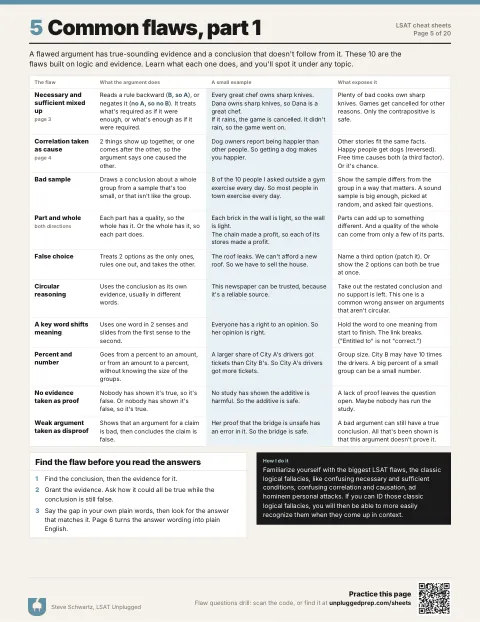
Keep the chain rules close with my free LSAT cheat sheet.
I've written free explanations for every question in LSAT PrepTest 159, 158, 157, 156, 155 and 154, with the right answer and why each wrong answer fails. All LSAT explanations are here.