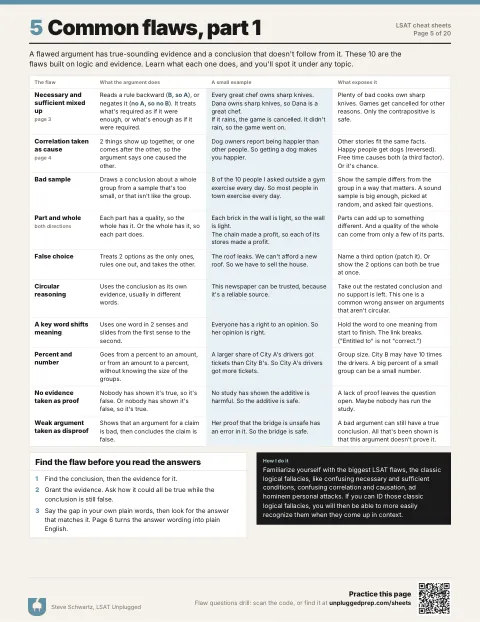
You're down to 2 answers. One small word picks the winner
You read the argument right and still missed it. Odds are one small word did it, like "some," "most," or "must." This board puts each one next to the question types that reward it, so watch where most of the lines run.
 lsatunplugged.com
You won't have this board on test day. Get the strength words on paper so they stick, with the free LSAT cheat sheet kit.
See every note as a list
Every claim has a size
Start here
Strength
How much a sentence claims. Some sentences claim a little and some claim a lot. Most Logical Reasoning answers turn on the difference.
"Some dogs bark" is small. "All dogs bark" is big.
Play Too Far, a free strength words game
Small claims
Easy to prove and hard to attack. They don't say much, so there's little to get wrong.
At least one dog barks.
- Small claims are low in strength
- Small claims win on Prove-it jobs
Big claims
Hard to prove. A single exception breaks one, so they're easy to attack.
Every dog barks. (Then you meet a basenji.)
Try 5 Sufficient Assumption questions
- Big claims are high in strength
- Big claims are welcome on Add-something jobs
The job
What the question asks the answer to do. Some jobs need a small answer and others welcome a big one, so name the job before you judge the choices.
Play Type Rush, a free question type game
- The job sets the limit on strength
- The job answers the proof question
The proof question
Ask which way the proof runs. When the passage has to prove the answer, small is safer. When the answer has to do work on the argument, big is fine.
Try 5 Most Strongly Supported questions
- The proof question tells you the safe level of strength
- The proof question sends some questions to Prove-it jobs
- The proof question sends the rest to Add-something jobs
How many
Quantity words
Some
At least one. It doesn't rule out all of them. "Many" and "several" prove about the same small thing.
Some dogs bark. Maybe they all do.
Play Valid or Not, a free logic game
- Some sits low on strength
- Some doesn't rule out "all"
Most
More than half. It doesn't rule out all of them either.
Play Valid or Not, a free logic game
- Most doesn't rule out "all"
- Most proves "some"
All
Every one, with no exceptions. "Any," "each," and "every" say the same thing.
Watch the free lesson: some, most, unless
- All sits high on strength
- All proves "most"
None
Zero. It's every bit as big a claim as "all." It just points the other way.
Watch the free lesson: some, most, unless
- None is as big a claim as "all"
Not all
At least one isn't. That's a small claim, even with the word "all" in it.
Not all dogs bark. One quiet dog makes it true.
Play Negate It, a free negation game
- Not all is what you get when you deny "all"
Only
Shuts every other door. But it says nothing about how many get through this one.
Only members can vote. That doesn't mean every member can.
Play Arrow Builder, a free if-then game
- Only often gets misread as "all"
How sure
Certainty words
Must
No other way it could be. "Will," "always," and "certainly" sit up here too.
Play Wiggle Room, a free must be true game
- Must sits at the top of strength
- Must is the how-sure version of "all"
Probably (Likely)
More likely than not. It leaves room to be wrong.
Try 5 Most Strongly Supported questions
- Probably falls short of "must"
- Probably proves "could"
Could (May, might, can)
Possible, and nothing more. Almost anything could happen, so it's very hard to disprove.
Play Wiggle Room, a free must be true game
- Could sits at the bottom of strength
- Could is the how-sure version of "some"
Cannot
Impossible. It takes as much proof as "must."
Watch the free lesson: must be true questions
- Cannot takes as much proof as "must"
Should
A recommendation. Facts alone can't prove one. Something in the reasons has to say what's good, bad, or worth doing.
The roads are icy, so the school should open late. Who says safety beats class time?
Play Rule Match, a free principle game
- Should needs a value in the reasons, or you get the jump
Causes
A claim that one thing makes another happen. It's much bigger than saying the 2 things show up together.
Watch the free lesson: correlation vs. cause
How often
"Always" and "never" sit at the 2 ends. "Usually" means more than half the time. "Sometimes" means at least once.
Play Too Far, a free strength words game
- How often runs on the same ladder as How many
The argument's size
Reasons in, conclusion out
The conclusion's size
Before you read the choices, note how much the conclusion claims. Is it certain, likely, or only possible? Is it about some, most, or all?
Try 5 Main Conclusion questions
- The conclusion's size is its strength
The jump
Small reasons, big conclusion. When the conclusion claims more than the reasons do, that's the weak spot.
Most students who used the flashcards passed. So the flashcards will work for anyone.
Play Gap Finder, a free missing link game
- The jump is a rise in strength
The hedge
A careful conclusion is hard to hit. "May help" survives attacks that would sink "will cure." Spot the hedge before you attack.
- The hedge shrinks the jump
- The hedge is easy to miss in a Weaken question
Comparisons
"Better than" doesn't mean "good." "More likely" doesn't mean "likely." A comparison claims an order and nothing else.
Play By the Numbers, a free numbers game
Parallel reasoning
Match the conclusion's strength first. If the original says "probably," cut every choice that concludes "must."
Try 5 Parallel Reasoning questions
- Parallel reasoning matches strength
- Parallel reasoning starts with the conclusion's size
Prove-it jobs
The passage has to back the answer
Must be true (Inference)
The passage has to prove the answer. The right one is usually boring and modest. If you can't point to the lines behind it, cut it.
- Must be true rewards low strength
Most strongly supported
Same direction, a little looser. Pick the claim the passage can carry, and be wary of big words.
Try 5 Most Strongly Supported questions
- Most strongly supported sets a slightly lower bar than a Must Be True question
Necessary assumption
Something the argument can't live without. Arguments rarely need anything big, so the tempting wrong answers say too much.
The flashcards helped at least some of the students who passed.
Try 5 Necessary Assumption questions
- Necessary assumption rewards low strength
- Necessary assumption gets tested by negating
Main conclusion
Restate the author's claim at the author's strength. If the author said "probably," the answer can't say "certainly."
Try 5 Main Conclusion questions
- Main conclusion keeps the author's strength
Describing the argument (Flaw, Method)
Flaw and method answers describe what the author did. If the answer says the author assumed "all" when "some" would do, it's the wrong description.
- Describing the argument names the jump
Agree or disagree (Point at issue)
Each speaker has to be on record. If a speaker said "some" and the choice says "most," that speaker never took a side on it.
Try 5 Agree or Disagree questions
- Agree or disagree punishes right idea, wrong size
Reading passages
Main point and inference answers in Reading Comprehension follow the same rule. They're rarely extreme.
Try 5 Reading Comprehension questions
- Reading passages follow the same rule as a Must Be True question
Add-something jobs
The answer does work on the argument
Sufficient assumption
The answer has to guarantee the conclusion. A hedged answer with "some" or "might" can't guarantee anything.
Whatever works for most students works for anyone.
Try 5 Sufficient Assumption questions
- Sufficient assumption needs high strength
- Sufficient assumption closes the jump
Strengthen
New information is welcome. A strong answer that helps a lot is fine. It doesn't have to prove the conclusion.
- Strengthen allows high strength
Weaken
You only have to make the argument shakier. The answer is still allowed to be strong, as long as it hits the reasoning.
- Weaken allows high strength
- Weaken aims at the jump
Principle
A broad rule is fine if it covers the case. "Any" and "always" are often what make the rule work.
- Principle often leans on "all"
Explain the clash (Resolve the paradox)
New facts are welcome here too. A reasonable answer is enough. You'll waste time hunting for an airtight one.
Try 5 Explain the Clash questions
- Explain the clash welcomes new facts, like a Strengthen question
Strong isn't wrong
On these jobs, never cut a choice just for saying "all" or "never." Cut it only if it doesn't do the job.
Play Called It, a free prediction game
- Strong isn't wrong protects good answers on Add-something jobs
- Strong isn't wrong is the flip side of too strong
When the size slips
Flaws and traps
Some becomes most
The reasons cover a few cases. The conclusion talks about most of them, or all of them.
3 friends loved the class, so everyone will.
Play Same Flaw, a free flaw game
- Some becomes most is a common form of the jump
Could becomes will
The reasons show something is possible. The conclusion treats it as certain.
- Could becomes will is another form of the jump
Together becomes causes
The reasons show 2 things happen together. The conclusion says one makes the other happen.
Play Case Board, a free cause and effect game
- Together becomes causes treats a pattern as a cause
Most plus most
Most A are B, and most B are C. That proves nothing about A and C.
Most kids like pizza. Most people who like pizza are adults. That doesn't make most kids adults.
Play Valid or Not, a free logic game
- Most plus most trips people up in a Must Be True question
Some are, so some aren't
"Some are" doesn't tell you that some aren't. Maybe they all are.
Play Valid or Not, a free logic game
- Some are, so some aren't forgets the top end of "some"
Too strong
A choice that's 95% right, wrecked by a single big word. Check for "always," "must," and "only."
Play Too Far, a free strength words game
- Too strong overshoots on strength
- Too strong is the usual trap on Prove-it jobs
- Too strong gets caught by the small word
Too weak to matter
On an add-something job, a choice that only says "some" or "might" often changes nothing.
- Too weak to matter falls short on strength
- Too weak to matter is the usual trap on Add-something jobs
Right idea, wrong size
The choice is on topic and points the right way. It just claims a little more, or a little less, than the passage did.
Play Too Far, a free strength words game
- Right idea, wrong size is a quieter kind of too strong
- Right idea, wrong size often stretches a comparison
Use it
Habits for test day
The small word
Find the strength word in a choice before you judge the rest. That word alone often decides it.
Watch the free lesson: some, most, unless
- The small word sets strength
Down to 2
Compare the strength words in the last 2 choices. Often one claims a bit more than the passage can carry.
Watch the free lesson: predict the answer before you look
- Down to 2 is often settled by strength
- Down to 2 starts with the small word
The guessing rule
Out of time and stuck? On prove-it jobs, lean toward the modest choice. On add-something jobs, strong is fine. Save it for when you'd otherwise guess blind.
Watch the free lesson: speed isn't the problem
- The guessing rule runs on strength
- The guessing rule comes from the proof question
A second set of eyes
If the same small words keep costing you points, an outside read finds the pattern fast. Steve Schwartz has been coaching the LSAT since 2005, and he teaches every free lesson himself.
- A second set of eyes is for when you keep missing on strength
Denying a claim
Negation, one word at a time
Negating
To deny a claim, take away only as much as you need. "All" becomes "not all," not "none." "Must" becomes "might not."
Play Negate It, a free negation game
- Negating changes strength
- Negating takes "all" down to "not all"
Denying "some"
You get "none." It takes zero to make "some" false.
Some dogs bark. Denied: no dog barks.
Play Negate It, a free negation game
- Denying "some" lands on "none"
Denying "most"
You get "half or fewer." You don't get "none," and you don't get "few."
Watch the free lesson: some, most, unless
- Denying "most" stops short of "none"
Denying "must"
You get "might not." It only takes one way out.
It must rain. Denied: it might not.
Play Negate It, a free negation game
- Denying "must" leaves one of the small claims
Denying "could"
You get "cannot." The small claim turns into a big one.
Play Negate It, a free negation game
- Denying "could" lands on "cannot"
Denying an if-then
Show the "if" part can happen without the "then" part. You don't flip the whole rule.
If it rains, the game is off. Denied: it can rain and the game still goes on.
Watch the free lesson: if-then basics
- Denying an if-then is how you test a rule in necessary assumption
You won't have this board on test day. Get the strength words on paper so they stick, with the free LSAT cheat sheet kit.
Questions people ask about LSAT Logical Reasoning answers
What does "some" mean on the LSAT?
At least one. It doesn't rule out all. "Some dogs bark" stays true even if every dog barks.
What does "most" mean on the LSAT?
More than half. Like "some," it doesn't rule out all.
Are answers with strong words like "all" or "never" always wrong on the LSAT?
No. It depends on the question. When the passage has to prove the answer, as in Must Be True, Most Strongly Supported, and Necessary Assumption questions, modest answers are safer. On Strengthen, Weaken, and Sufficient Assumption questions, a strong answer is fine as long as it does the job.
How do I choose between 2 answer choices in Logical Reasoning?
Compare their strength words. Often one choice claims a little more than the passage can back. Then check what the question allows. Some question types need a modest answer and others welcome a strong one.
How do I negate "all" or "some" on the LSAT?
Take away only as much as you need. The negation of "all" is "not all," and the negation of "some" is "none." "Must" becomes "might not."