Free LSAT Logic Game | Grouping: Selection / In-Out
Note: the LSAT no longer has Logic Games. LSAC removed the section in August 2024. From August 2024 through June 2027, the scored test is 2 Logical Reasoning sections and 1 Reading Comprehension section. This post stays up as an archive, and the reasoning skills still carry over, but you won’t see a game on test day.
I’ve enjoyed forcing you to think about a spaceship with 8 monkeys and 7 Greek deities in a power struggle as you completed my first two LSAT Logic Games.
However, it’s time to get back to the real world, at least for a little while, so the Logic Game I’ve written this time has a more standard topic.
The setup and rules
On Wednesday, a legislator remembers that she must vote on seven bills-defense, environment, free trade, gun control, health care, immigration, and judicial activism-by the end of the week. Because the legislator wants to align herself with a major political party, she will vote on the seven bills in accordance with the following conditions:
She votes for the gun control bill only if she votes against the environment bill.
Unless she votes against the judicial activism bill, she will vote for the immigration bill.
She will vote for either the environment bill, the judicial activism bill, or both.
She votes for the gun control bill if she votes for both the health care bill and the defense bill.
The questions
1. Which one of the following could be a complete and accurate list of the bills the legislator votes against?
(A) free trade, gun control, immigration, judicial activism
(B) defense, free trade, gun control, health care, immigration
(C) free trade, health care, immigration, judicial activism
(D) environment, gun control, health care, judicial activism
(E) defense, environment, gun control, health care
2. If the legislator votes against the judicial activism bill, then which one of the following CANNOT be true?
(A) She votes against both the defense bill and the gun control bill.
(B) She votes against both the gun control bill and the health care bill.
(C) She votes for both the health care bill and the defense bill.
(D) She votes for both the health care bill and the environment bill.
(E) She votes for both the environment bill and the free trade bill.
3. Which one of the following CANNOT be true?
(A) The legislator votes for neither the gun control bill nor the immigration bill.
(B) The legislator votes for neither the environment bill nor the immigration bill.
(C) The legislator votes for neither the gun control bill nor the health care bill.
(D) The legislator votes for neither the health care bill nor the free trade bill.
(E) The legislator votes for neither the free trade bill nor the immigration bill.
4. If the legislator votes against the immigration bill, then which one of the following is the minimum number of the seven bills she must also vote against?
(A) one
(B) two
(C) three
(D) four
(E) five
5. If the legislator votes for the gun control bill, then which one of the following must be true?
(A) She votes for the health care bill or the defense bill.
(B) She votes against the health care bill or the defense bill.
(C) She votes against the judicial activism bill.
(D) She votes for the immigration bill.
(E) She votes against the immigration bill.
6. If the legislator votes against the judicial activism bill, then each of the following could be true EXCEPT:
(A) She votes against the health care bill and the defense bill.
(B) She votes for the health care bill and the defense bill.
(C) She votes against the health care bill and the gun control bill.
(D) She votes against the free trade bill and the gun control bill.
(E) She votes for the environment bill and the free trade bill.
7. Suppose the condition is added that if the legislator votes for the free trade bill, then she will vote against the judicial activism bill. If all other conditions remain in effect, then each of the following must be true EXCEPT:
(A) If she votes for the free trade bill, then she votes against the gun control bill.
(B) If she votes against the environment bill, then she also votes against the free trade bill.
(C) If she votes against the immigration bill, then she votes for the free trade bill.
(D) If she votes against the judicial activism bill, then she also votes against the gun control bill.
(E) If she votes against the immigration bill, then she also votes against at least three other bills.

Answers and full explanation
The text below contains the answers to the above Logic Game.
- E
- C
- B
- C
- D
- B
- C
How to diagram the rules
Try the game on your own first, then read my setup below.
This is an In-Out game where the rules can be connected to form long conditional chains.
I designate bills voted “For” as being “In” (positive). I designate the bills voted “Against” as being “Out” (negative).
If you’re new to this, or you need a reminder, sufficient is before the arrow, and necessary is after the arrow: Sufficient -> Necessary (see this for more details).
To flip a rule without breaking it, see my guide to the contrapositive and the 2 mistakes that look like it.
First rule
G only if NOT E can be diagrammed as

(“only if” introduces the necessary condition)
The contrapositive, would be:

Second rule
(I skip this rule because it mentions variables not mentioned in the first rule. Put a mark next to this rule as a reminder to come back to it.)
Third rule
This means at least one of E and J must be in, but there’s no reason we can’t have both in.
This can be diagrammed as:
NOT E -> J
Contrapositive:
NOT J -> E
By connecting this rule (and its contrapositive) to the first rule (and its contrapositive), we get:

and

Second rule
Now that we have J on our diagram, it’s worth taking a look at the second rule because we’ll be able to connect the variables in this rule to what we already have on our diagram.
The word “unless” is tricky, but I’ve explained it here.
If you like, you can switch the order of the clauses in this rule in order to think of the rule as “I unless NOT J”
This becomes “NOT I -> NOT J”
Contrapositive:
J -> I
We can immediately connect this rule (and its contrapositive) to what we’ve already diagrammed, giving us:

and

Fourth rule
If introduces the sufficient condition, so it should really be thought of as:
H + D -> G
(H and D being in are sufficient to guarantee that G is in.)
Contrapositive:
NOT G -> NOT H or NOT D
On the diagram, it becomes:

Remember that the word “or” is inclusive. This means that if G is out, at least one of H and D will be out, but perhaps both of them will be out.
For the “or,” some people like to use a dotted-line arrow rather than a solid line and writing the word “or.” With a dotted-line arrow, this rule would look like:

Either way is fine, as long as you know what it means.
Question 7’s rule
Question 7 adds a new rule: F –> NOT J
Take the contrapositive: J –> NOT F
Add both to the diagram, and you get:

With the rules correctly diagrammed in these chains, you should be able to get through the game’s questions on your own. Most of the difficulty is in setting up the game and forming the chains.
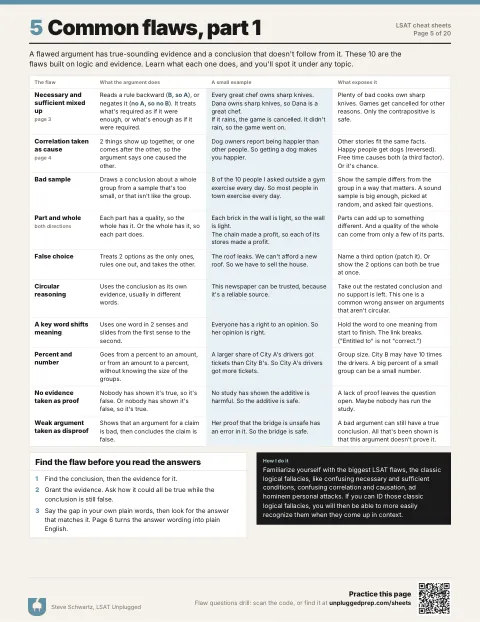
If you keep missing the same questions, my free LSAT cheat sheet has a page for each topic.
Get the free LSAT cheat sheetI've written free explanations for every question in LSAT PrepTest 159, 158, 157, 156, 155 and 154, with the right answer and why each wrong answer fails. All LSAT explanations are here.
Enough reading. Try a question. Free LSAT drills, 1 at a time, explained the second you answer. Start free drills