Free Courses › Logical Reasoning
Harder reasoning · Bonus lesson
Causal or conditional? How to tell
After this lesson, you can tell a causal claim from a conditional one in a few seconds, even with no indicator words, and pick the right attack for each.
A written lesson: about a 6 minute read, plus a 5-question self-check below
A causal claim says one thing makes another happen. A conditional claim says one thing guarantees or requires another, and it never says why. To tell them apart, ask one question: is the author explaining why something happened, or stating a rule about what must be true? The answer decides which flaws to look for and which answer choices can hurt the argument.
In this lesson
- Tell a causal claim from a conditional one with a single question: is this a why, or a rule?
- Spot the words that usually flag each type, and the word that fools people because it can flag either
- Handle a stimulus with no indicator words by reading it like a normal conversation
- Match each type to its usual flaw and its usual weakener
The one-question test: is it a why, or a rule?
A causal claim tells you why something happened. "The new traffic light reduced accidents on Main Street." The light made a change in the world. Take the light away and, according to the author, the accidents come back.
A conditional claim tells you what has to be true when something else is true. "Every driver on Main Street must stop at the light." That's a rule. It doesn't explain anything. It just says: if you're driving on Main Street, then you stop at the light.
So when you're not sure which one you're looking at, ask yourself: is the author explaining why B happened, or telling me that A guarantees B (or that B is required for A)? A why is causal. A rule is conditional. Honestly, that question settles most cases in a couple of seconds.
One gray zone: some rules describe physical facts. "If you drop the glass, it breaks" sounds causal. Look at what the argument does with it. If it applies the rule to a case ("she dropped the glass, so it broke"), work it like a conditional. If it argues about what produced a result ("the glass broke, so someone must have dropped it"), that's a causal story, and other explanations matter.
Words that usually flag each type
Conditional claims tend to come with rule words: if, only if, unless, without, until, all, every, any, each, whenever, must, requires, depends on. Some of these are annoying (unless and without trip up a lot of students), and they're worth drilling until you read them without thinking. The conditional reasoning lesson covers how each one translates.
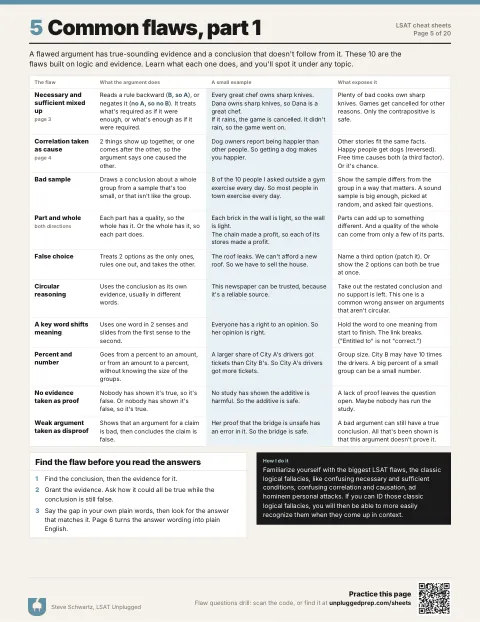
Causal claims tend to come with cause words: causes, leads to, results in, produces, is responsible for, contributes to, explains why, is due to, the effect of. You'll also see causal arguments built on data with no cause word in the evidence at all: 2 numbers that move together, and then a conclusion that one drives the other. That's the correlation pattern from lesson 11.
The word that fools people is because. It can flag evidence ("we should cancel the picnic because rain is forecast"), or it can flag a cause ("the picnic was canceled because of the rain"). Personally, I treat "because" as neutral. It points at the support and says nothing about what kind of claim you're reading, so run the why-or-rule question on it anyway.
No indicator words? Read it like a conversation
Plenty of stimuli give you no clean signal. When that happens, don't reach for a diagram. Most Logical Reasoning arguments are informal, and turning the nouns into letters doesn't get you any closer to the answer. Instead, read it the way you'd hear it from a friend.
If a friend said "my coffee keeps me awake at night," you'd hear a cause right away, and you'd probably ask: are you sure it's not the late-night phone scrolling? If a friend said "you can't get into that club without a reservation," you'd hear a rule, and you wouldn't ask why. You'd ask whether you have a reservation. Poking at a cause and checking a rule are exactly the 2 reactions the LSAT is looking for.
And the test rarely asks you to label a claim as causal or conditional. It asks you to weaken, strengthen, find the flaw, or resolve the paradox. The label is only useful because it tells you what to look for next.
Why the difference changes your answer
Causal arguments break in predictable ways. Something else could be the cause (a third factor), the cause could run the other way, or the link could be a coincidence. So an answer that weakens names another explanation, and an answer that strengthens rules one out. A necessary assumption usually sounds like: nothing else explains the result.
Conditional arguments break in different ways. The classic mistakes are flipping the rule (A guarantees B, B happened, so A happened) and negating it (A guarantees B, A didn't happen, so B didn't). If a conditional argument applies its rule correctly, an alternative cause does nothing to it, because the argument never claimed to explain why.
That's why mixing them up costs points. If you read a conditional argument as causal, you'll go hunting for an alternative explanation that doesn't matter. If you read a causal argument as a rule, you'll miss the obvious weakener sitting right there in the answer choices.
Try it yourself: 5-question self-check
For each statement, decide: causal or conditional? Say why in a few words before you open the answer.
1. Every member of the debate team also takes Latin.
Show the answer
Answer: Conditional.
It's a rule about group membership: if you're on the debate team, then you take Latin. It says nothing about why. Debate doesn't cause Latin.
2. Ever since the cafe started playing slower music, customers have been staying longer. The music is keeping them in their seats.
Show the answer
Answer: Causal.
The author explains why customers stay longer: the music. It's built on 2 things changing at the same time, so look for another explanation (new chairs, colder weather outside).
3. You can't renew your parking permit unless you've paid last year's fines.
Show the answer
Answer: Conditional.
"Unless" sets up a requirement: if you renew, then you paid the fines. Paying the fines doesn't cause a renewal. It's just required for one.
4. Because the bakery's only oven broke on Friday, it sold no bread that weekend.
Show the answer
Answer: Causal.
Here "because" names a cause: the broken oven made the bread sales stop. Run the why-or-rule question and you get a why.
5. This firm hires only lawyers who've passed the bar. Rafael works at the firm as a lawyer, so he must have passed the bar.
Show the answer
Answer: Conditional.
"Only" sets up a requirement: hired as a lawyer here, then passed the bar. The argument applies the rule to Rafael. Nothing in it explains why anything happened.
The short version
- On your next practice set, before you read the answer choices, label the conclusion's claim: why or rule. Then predict the weakener or the flaw from that label.
- When you see "because," don't assume either one. Ask the why-or-rule question every time.
- If you catch yourself looking for an alternative cause in a conditional argument, stop. That answer can't hurt it.
Free download
The Logical Reasoning companion pack
Every lesson’s notes, key rules, and practice questions in 1 PDF, emailed to you. The videos teach. The pack is what you review from.
I’ll also send you my best LSAT strategies. Unsubscribe anytime.
Common questions
What's the difference between causal and conditional reasoning on the LSAT?
Causal reasoning claims that one thing makes another happen. Conditional reasoning states a rule: one thing guarantees another, or one thing is required for another. A causal claim explains why. A conditional claim never does.
Is "because" a causal indicator or a conditional indicator?
Neither, on its own. "Because" marks the support in an argument, and it can introduce a cause or just a reason. Ask whether the sentence explains why something happened (causal) or states a rule (conditional).
How do you weaken a causal argument versus a conditional one?
Weaken a causal argument by showing another explanation fits: a third factor, the cause running the other way, or coincidence. A valid conditional argument can't be weakened that way. Conditional arguments fail when they flip or negate their rule, which is a flaw in the logic, not a missing explanation.
Do I need to diagram to tell causal from conditional?
Usually not. Most Logical Reasoning arguments are informal. Diagramming helps when several formal conditional statements link together. Otherwise, read the stimulus like a normal conversation and ask whether it's a why or a rule.
Want the key LSAT rules in one place? Get the free LSAT cheat sheet.