The clock is a review problem
Timing comes up with most of my students, and usually they bring it up, usually in the first five minutes, usually in the same words: I know the material, I just run out of time. I believe the first half of that sentence more often than the second. A student who runs out of time almost always has a review problem that shows up as a clock problem, and the fix is almost never to read faster.
In my experience the Logical Reasoning section runs roughly in order of difficulty. The first ten questions are usually the easiest, and the hardest cluster sits somewhere around fifteen to twenty-three. A student who gives every question the same ninety seconds spends too long on the first ten and arrives at the hard ones with nothing left. They run out of time on the questions that needed it, because they spent it on the ones that didn’t.
I call the fix the time bank.
Ten questions, ten to twelve minutes
Kevin, first session. He wanted a 180, had almost no free time, and told me his pace on the argument sections had slowed since he’d started using a more careful method. He asked what pace to hold.
I gave him a number, the same one I give everybody.
“You want to get through the first ten questions in roughly ten to twelve minutes. You’re solving the earlier questions at a faster pace to build up a time bank that you can then apply to the tougher questions later in the section. So we’re looking at roughly a minute per question. You have on average about a minute twenty-five per question.”
Then I told him what I do myself, which surprised him.
“Personally, I’ll flag four questions in a single section of Logical Reasoning, just because I don’t want to deal with them in the moment, because everything’s worth the same.”
Four. On a section where I’m not going to miss any of them. The flags are the questions that would cost more than their share of the time bank if I did them in order. Every question is worth exactly one point, so there’s no reason to pay three minutes for one when a question further on costs one minute for one.
“Is it a question where the choices are virtually indistinguishable? It’s a time sink, and it’s only worth one raw score point. Don’t fall into that quicksand. Just flag it, skip it, come back to it later.”
If you’ve worked with me, you’ve heard all four of those, probably in the same minute.
Owen got the same rule for the question type he missed most:
“Since everything’s worth the same, I would make sure that you don’t get too bogged down in any one question. If this takes too long, and you find it’s consistently the one that gives you the most trouble, I would just flag it, skip it, come back to it later.”
Seven p.m., not three a.m.
Lucas had an extended-time accommodation and a fear of the clock that followed him into every section. In our fifth session he’d decided his real problem was timing, because every mistake looked easy in hindsight. He said the first part of each Logical Reasoning section went fast, and reading still felt rushed.
The arithmetic hadn’t landed, so I gave him an image.
“We need to set up your foundation so that you’re going faster on the easier ones, so that you have sufficient time remaining, so that you’re getting to that winding road at seven p.m. rather than three a.m.”
The hard questions are the winding road. You’re going to drive it either way. You can arrive rested with the headlights on, or exhausted at three in the morning with the clock about to run out. Every second you save on question four is a second of daylight on question nineteen.
Then I tied the clock back to the calendar.
“The timeline factors in here also. When your LSAT test date is coming up sooner, we want you spending less time drilling and more time doing timed work.”
Timing is what your review habits look like under pressure. A student whose prephrase is reliable reads choices fast, and a student who goes to the text for every kept choice doesn’t flip between two of them for three minutes.
What was different?
The best timing diagnosis I’ve seen came from a question I asked and a student answered.
Marcus, fourth session. He’d taken two practice tests close together. One, timed and in one sitting, came out at 158. The other, relaxed and split across two sittings, came out at 167. Nine points, same student, same week.
“So when you look at these two results, what do you notice that might’ve been different, in your experience, when it came to the timing or the pacing, anything like that?”
He said the timing and the nerves. Then he described the pattern, and it was precise. Slow on the early questions, then a rush and a freak-out somewhere around questions eleven to thirteen, then wrong answers from twenty to twenty-four, then out of time before the last click.
“So when you say that you were freaking out on specific ones in the middle, could that have been impacting your performance afterwards?”
Yes. The panic in the middle cost the end of the section too, because he reached the hard cluster already rattled and already behind. He’d diagnosed it himself in about two minutes, from two numbers and one question. Everything we did on timing after that was built on his description.
Are you scoring yourself in between?
Sometimes the clock problem isn’t the clock at all. Sofia, sixth session, told me that after each section of a practice test she swung between feeling fine and feeling terrible. She’d either try to fix a bad feeling by doing another section (which made it worse) or skip the next section and feel guilty.
I asked one question.
“Are you scoring yourself in between?”
She was. After every section, she checked her answers.
“You can’t score yourself in between. It’s not realistic for test day, right? So test day, you’re not going to know for a few weeks. And so that ten-minute break, which is not an hour, it’s just ten minutes. If you want to go outside, that’s fine. Take a walk, get a snack, go to the bathroom, whatever, that’s all fine. But you can’t check your answers. And that can contribute to all the mental questioning.”
The mood swings came from the procedure. She’d built a practice routine that fed her a score between sections, and then she was surprised the score affected the next section. Take the score away and the swings had nothing to feed on. Speed had nothing to do with it. You only find this kind of problem if you ask what the student actually does between sections.
What this has to do with review
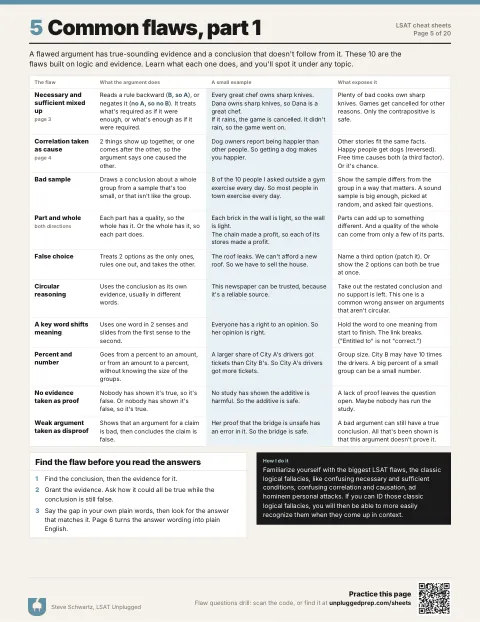
This is why timing is in a book about review. The time bank only fills if the easy questions are actually easy for you, and they’re only easy once you’ve found and fixed the skeletons that make them hard. A student who still confuses necessary with sufficient will spend two minutes on a question-six assumption question that should take fifty seconds. That two minutes comes straight out of question nineteen.
So it’s review first, then speed. I told Sofia this flatly in her fourth session:
“You’ll get there bit by bit, step by step. Accuracy first, learn the material, then you add the timing.”
Students ask me all the time whether to work on timing or accuracy. A miss is a miss either way, and my answer doesn’t change.
“Both are really important and getting faster comes from understanding the questions better. There’s nothing more to it than that.”
When a student is accurate but slow, the problem is almost always one of three habits from this chapter. They give every question the same time, they refuse to flag, or they let the middle of the section wreck the end. None of those is a reading-speed problem. All three are fixable in a week if you watch what you actually do with the clock.
Run it yourself
Next timed section, keep a scratch list. Write the question number of every question you spend more than ninety seconds on, and whether you flagged it. After the section, before scoring, look at the list. Count how many of those numbers are under ten. Every one of them is a withdrawal from the time bank on a question that should have been a deposit. Then score the section and look at what happened after question fifteen. If the misses cluster there, you’ve just watched the first ten pay for the last ten, in the wrong direction.
Then write the takeaway as a rule, in the first person, about the whole section. Here’s how I’d write one for a student who got stuck on question seventeen and let it bleed into eighteen:
“I want to recognize that every single question is worth the same amount, and so it is not worth it to spend too long on any one question. Instead, I should have flagged question number 17, skipped it, and then trusted that I would be able to come back to it later”