Free Courses › Logical Reasoning
Harder reasoning · Bonus lesson
LSAT logic words: some, most, unless, and/or
After this lesson, you can translate some, most, unless, and and/or statements, negate each one correctly, and write a valid contrapositive when a rule has an and or an or in it.
The short answer: On the LSAT, "some" means at least 1 and "most" means more than half, and both could turn out to be all. To negate a statement, make the smallest change that makes it false (the negation of "all" is "not all," never "none"). The word after "unless" is the necessary condition. And when you take a contrapositive, "and" turns into "or" and "or" turns into "and."
A written lesson: about a 5 minute read, 4 tables, plus 1 practice question below
In this lesson
- Read some, most, all, and none the way the test does, which isn't how people talk
- Negate any statement with the smallest change that makes it false, so the negation test on necessary assumption questions works
- Turn an unless sentence into an if-then in 2 steps, and skip the trap of reading it backward
- Write the contrapositive of a rule with and or or in it, and know which rules you can split in 2
What some and most mean on the LSAT
In real life, "most of my friends came to the party" hints that a few didn't. On the LSAT it hints at nothing. "Most" means more than half, and that's the whole promise. It could be 51% or 100%. "Some" is even looser: at least 1, and possibly all.
So when a stimulus (the short passage above the question) says some or most, don't add "but not all." The test writers know you will, and they write wrong answers that only work if you did.
| Word | What it guarantees | Could it be all? | Can you swap A and B? |
|---|---|---|---|
| All A are B | Every A is a B | It is all | No. All A are B doesn't mean all B are A |
| Most A are B | More than half of the As | Yes | No. Most A are B tells you nothing about most B |
| Some A are B | At least 1 A is a B | Yes | Yes. Some A are B means some B are A |
| No A are B | Zero | No | Yes. No A are B means no B are A |
One combo shows up a lot. If most A are B and most A are C, then at least some A are both B and C. Each of those groups holds more than half of the As, so they have to overlap. Swap in "some" and the overlap is gone. Some A could be B and some A could be C with no A in both.
How to negate a statement
The negation is the smallest change that makes a statement false. Not the opposite. The opposite of "all of my students passed" is "none of them passed," but you prove the original false with a single student who failed. So the negation is "not all of them passed."
This matters most on necessary assumption questions. You negate an answer choice, and if the argument falls apart, that's your answer. Negate too hard and a wrong answer looks like it kills the argument. Here's the full list.
| Statement | Correct negation | Common mistake |
|---|---|---|
| All A are B | Not all A are B (at least 1 A isn't B) | No A are B |
| Most A are B | Half or fewer of the As are B | Most A aren't B |
| Some A are B | No A are B | Some A aren't B |
| No A are B | Some A are B (at least 1) | All A are B |
| If A, then B | A can happen without B | If A, then not B |
| A and B | Not A, or not B (at least 1 fails) | Neither A nor B |
| A or B | Neither A nor B | Not A, or not B |
Look at the conditional row. Negating "if A, then B" doesn't mean A blocks B. It just means A doesn't guarantee B. For reps, Negate It is a free game that drills exactly these swaps, and it flags the ones that are too strong.
The unless rule
"Unless" trips people up because it doesn't sit neatly on either side of the arrow. Quick refresher: in "if A, then B," A is the sufficient condition (the trigger) and B is the necessary condition (what has to be true once the trigger happens). We write it A → B. Here's the unless version I teach, in 2 steps. First, whatever comes right after "unless" is the necessary condition. Second, take the rest of the sentence, negate it, and make that the sufficient condition.
Take "Ana won't run the marathon unless her knee heals." The part after unless is "her knee heals," so that's necessary. The rest is "Ana won't run." Negate it to "Ana runs" and you get: if Ana runs the marathon, her knee healed. "Without" and "until" work the same way.
| Sentence | If-then version | Contrapositive |
|---|---|---|
| Ana won't run the marathon unless her knee heals | Ana runs → knee healed | Knee doesn't heal → Ana doesn't run |
| The museum closes early unless a guide is on shift | Museum doesn't close early → guide on shift | No guide on shift → museum closes early |
| Without a permit, the food truck can't park downtown | Truck parks downtown → permit | No permit → truck doesn't park downtown |
| The store won't reopen until the roof is fixed | Store reopens → roof fixed | Roof not fixed → store doesn't reopen |
Now the trap. "Unless" only runs 1 way. If Ana's knee heals, you know nothing about whether she runs. Maybe she's busy that weekend. Wrong answers love to read unless as if it worked in both directions, so that's the first thing to check when you see one.
Contrapositives with and and or
The contrapositive is the one flip that's always valid: swap the 2 sides and negate both. (If A → B, then not B → not A. The conditional reasoning lesson covers why.) When a side has an "and" or an "or" in it, add 1 more step. Swap the and for an or, or the or for an and.
Take "If it's sunny and warm, Leo bikes to work." Say Leo didn't bike. You can't tell which part failed. Maybe it wasn't sunny, maybe it wasn't warm, maybe neither. So you get: if Leo doesn't bike, then it wasn't sunny or it wasn't warm.
| Original rule | Contrapositive | Can you split it in 2? |
|---|---|---|
| If A and B, then C | If not C, then not A or not B | No |
| If A, then B and C | If not B or not C, then not A | Yes: A → B, and A → C |
| If A or B, then C | If not C, then not A and not B | Yes: A → C, and B → C |
| If A, then B or C | If not B and not C, then not A | No |
The split column saves time. An "and" on the right side, or an "or" on the left side, breaks into 2 simple rules you can link up with the other rules in the passage. The other 2 shapes don't break apart, so keep them whole. A wrong answer that splits them is making a claim the stimulus never made.
Try it yourself
Unless the forecast calls for lightning, the rowing club practices on the lake. If the club practices on the lake, both the coach and the captain arrive early. Today the captain didn't arrive early. Which of the following must be true?
(A) The coach didn't arrive early today.
(B) The forecast called for lightning today.
(C) The club practiced indoors today.
(D) Whenever the forecast calls for lightning, the club skips the lake.
Show the answer
Answer: (B)
The lake rule's necessary side is "coach and captain early." The captain wasn't early, so by the contrapositive the club didn't practice on the lake. Run the unless rule: no lightning forecast means a lake practice, so no lake practice means the forecast called for lightning. (A) assumes both parts of the and failed, when 1 failing is enough. (C) invents an indoor practice the stimulus never mentions. (D) reads unless as if it worked in both directions.
The short version
- Every time you see some or most in a stimulus, say "could be all" in your head before you look at the answers.
- Before you run the negation test, check the negation against the table above. If yours says none, never, or neither, ask whether it's too strong.
- When you diagram unless, write the word after it on the right side of the arrow first, then negate the rest. Never read it backward.
- When a contrapositive has an and or an or, swap it, then check whether the rule splits before you link it to other rules.
Free download
The Logical Reasoning companion pack
Every lesson’s notes, key rules, and practice questions in 1 PDF, emailed to you. The videos teach. The pack is what you review from.
I’ll also send you my best LSAT strategies. Unsubscribe anytime.
Common questions about LSAT logic words
What does "most" mean on the LSAT?
More than half, anywhere from just over 50% up to 100%. It doesn't rule out "all."
What does "some" mean on the LSAT?
At least 1. It could be 1, it could be half, and it could be all. It never implies "some but not all."
What is the negation of "all" on the LSAT?
"Not all," meaning at least 1 isn't. "None" is too strong, and it's a common mistake on necessary assumption questions.
How do you translate "unless" on the LSAT?
The part right after "unless" is the necessary condition. Negate the rest of the sentence and make it the sufficient condition. "A unless B" becomes: if not A, then B.
What happens to "and" and "or" in a contrapositive?
They swap. Flip the 2 sides, negate both, and turn every "and" into "or" and every "or" into "and."
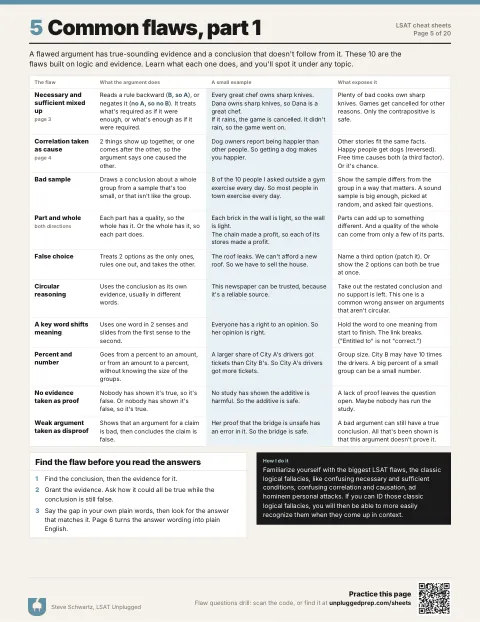
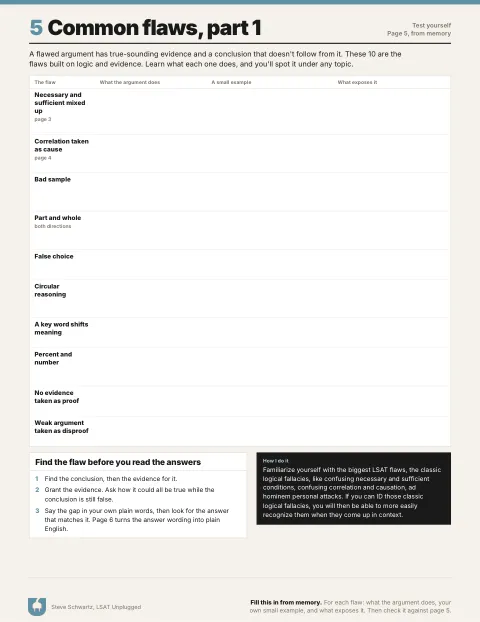
Want the key LSAT rules in one place? Get the free LSAT cheat sheet.