Stop studying the LSAT one topic at a time
There's a missing piece in almost every LSAT argument. The tour shows you where it hides, and how much of the test hangs off that one spot.
 lsatunplugged.com
You won't remember this board on test day. Get it on paper with the free LSAT cheat sheet kit.
See every note as a list
If-then logic
Rules and what follows from them
If-then rules
If A, then B. A is enough to get B. B is required for A. Shorthand: A → B.
If you live in Boston, you live in Massachusetts.
- If-then rules flips safely into The one safe flip
- If-then rules can be broken by The 2 bad flips
- If-then rules links up into Chains
The one safe flip (Contrapositive)
Swap the 2 sides and add "not" to both. If not B, then not A. True any time the rule is.
Not in Massachusetts, so not in Boston.
The 2 bad flips
Swapping the sides with no "not" (B, so A). Or adding "not" with no swap (not A, so not B). Neither follows.
In Massachusetts, so in Boston. Nope.
Enough vs. required words
"If," "when," "every," and "all" mark the enough side. "Only if," "requires," and "must" mark the required side. "Unless" means "if not."
- Enough vs. required words tell you how to build If-then rules
Chains
If A, then B. If B, then C. So if A, then C.
Some, most, all
"Some" means at least one, and could be all. "Most" means more than half, and could be all. "All" means every one.
- Some, most, all decide what's proven in Must be true
- Some, most, all misread, give you Too strong
Questions that change the gap
Logical Reasoning, short arguments
What the argument needs (Necessary assumption)
An unstated idea the argument can't survive without. It doesn't have to prove the claim. It only has to be needed.
The roads will be less icy later this morning.
Try 5 Necessary Assumption questions
- What the argument needs is an Assumption
- What the argument needs fills part of The gap
- What the argument needs sits on the required side of If-then rules
- What the argument needs denied, becomes a Weaken
What would prove it (Sufficient assumption)
A statement that, once added, makes the conclusion certain.
Any time the roads are icy in the morning, the school should open late.
Try 5 Sufficient Assumption questions
- What would prove it is an Assumption
- What would prove it closes The gap
- What would prove it sits on the enough side of If-then rules
The negation test
Say the answer choice isn't true. ("All" becomes "not all," not "none.") If the argument dies, the choice was needed.
The roads won't be any less icy later. Then why open late?
Try 5 Necessary Assumption questions
- The negation test checks for What the argument needs
Strengthen
Make the conclusion more likely. The answer doesn't have to prove it.
The forecast says it'll be above freezing by 10.
- Strengthen narrows The gap
Weaken
Make the conclusion less likely. The answer doesn't have to disprove it.
The forecast says it'll get colder all day.
- Weaken widens The gap
Evaluate
Find the question you'd want answered. One answer helps the argument. The other hurts it.
Will the roads be safer later this morning?
- Evaluate asks about The gap
Principle
A general rule. Find one that backs up the step, or apply one to a new case.
Schools should wait to open whenever waiting makes the trip safer.
- Principle bridges with a rule The gap
- Principle often works like What would prove it
Questions that describe the argument
Logical Reasoning, short arguments
Flaw
Say what went wrong in plain words before you read the choices.
Takes for granted that waiting makes the trip safer.
- Flaw names The gap
- Flaw usually names one of the Common gaps
Method (Method of reasoning)
How the argument gets there: an example, a comparison, ruling out other options.
- Method describes the route from the Premises
Role (Role of the statement)
What one sentence is doing: conclusion, reason, middle step, or background.
- Role often asks about a Middle step
Main conclusion
Name the claim everything else supports. It often isn't the last sentence.
Try 5 Main Conclusion questions
- Main conclusion asks for the Conclusion
Parallel reasoning
Find the argument with the same shape. Ignore the topic.
Try 5 Parallel Reasoning questions
- Parallel reasoning often matches the shape of If-then rules
- Parallel reasoning can copy a Flaw
Agree or disagree (Point at issue)
2 speakers. Find the claim one says yes to and the other says no to. If either has no opinion on it, cut it.
Try 5 Agree or Disagree questions
- Agree or disagree tracks 2 views, like Background and other views
Common gaps
The same mistakes, again and again
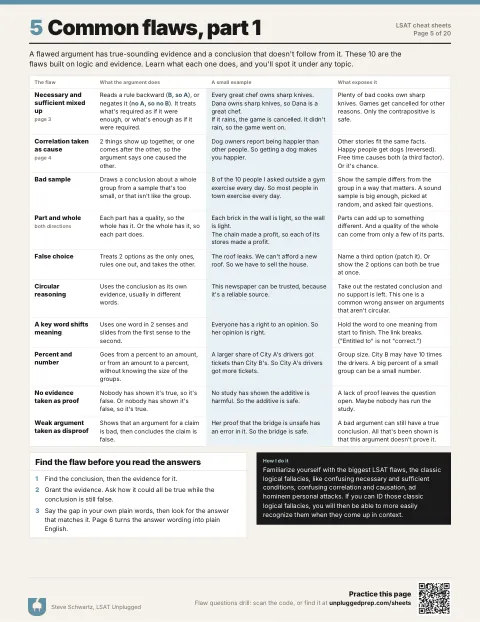
Correlation as cause
2 things show up together, so the argument says one caused the other.
Dog owners are happier, so dogs make people happy.
- Correlation as cause is answered by Other causes
- Correlation as cause is a classic The gap
Other causes
Another cause, the reverse cause, or plain chance. The standard ways to doubt a causal claim.
Maybe happy people are the ones who get dogs.
- Other causes are the go-to tool for Weaken
- Other causes ruled out, become a Strengthen
Enough mixed up with required
Treats something required as if it were enough. Or treats something that's enough as if it were required.
You need a ticket to get in. I have a ticket, so I'll get in.
- Enough mixed up with required is the flaw version of The 2 bad flips
Bad sample
Too small, or not like the group the conclusion is about.
Judges the source, not the claim
Rejects a claim because of who said it. Or accepts one from someone who's no expert on the topic.
One word, two meanings
A key word quietly changes meaning between reason and conclusion.
No proof isn't disproof
Treats a lack of evidence for a claim as evidence against it.
Part vs. whole
True of each part, so true of the whole. Or the reverse.
False choice
Treats 2 options as the only ones.
Rates vs. numbers
A bigger share doesn't mean a bigger count, and a bigger count doesn't mean a bigger share.
Every argument
Where it all starts
Argument
A claim plus the reasons given for it. Logical Reasoning hands you a short one, then asks about it.
- Argument is made of Premises
- Argument ends in a Conclusion
Conclusion
The claim the author wants you to buy. Find it before you do anything else.
So the school should open late.
Try 5 Main Conclusion questions
Middle step (Sub-conclusion)
A claim that gets support, then gives support to the main conclusion.
The roads are icy, so the buses will run slow, so the school should open late.
- Middle step supports the Conclusion
Signal words
"So," "thus," and "therefore" point to a conclusion. "Because," "since," and "for" point to a reason.
- Signal words point to the Conclusion
- Signal words point to the Premises
The gap
The space between the reasons and the claim. The author needs something there and never says it. Most Logical Reasoning questions poke at this space.
Icy roads, so open late. That only works if opening late makes the trip safer. That's the gap.
- The gap sits under the Conclusion
Assumption
Something the author needs to be true but never says. It lives in the gap.
Opening late will make the trip safer.
Try 5 Sufficient Assumption questions
- Assumption lives in The gap
Background and other views
Context, or a view the author rejects. "Some say" often sets up the opposite.
- Background and other views can set up the opposite of the Conclusion
Premises
The reasons. Treat them as true. You judge the step, not the facts.
The roads are icy this morning.
- Premises support the Conclusion
- Premises can support a Middle step
- Premises leave The gap
Questions with facts, no argument
Logical Reasoning, short passages of facts
Must be true
Proven by the statements given. Nothing added, nothing assumed.
Every bus was late. Ana took a bus. So Ana was late.
- Must be true treats every statement like the Premises
- Must be true punishes Too strong
Most strongly supported
Backed by the statements, not proven. Modest wording usually wins.
Try 5 Most Strongly Supported questions
- Most strongly supported is the looser cousin of Must be true
Explain the clash (Resolve the paradox)
2 facts seem to fight. Pick the answer that lets both be true.
Try 5 Explain the Clash questions
- Explain the clash accepts both facts like Premises
Wrong answers
Wrong in the same few ways
Cut, don't pick
Don't hunt for the best-sounding choice. Cut the ones you can prove wrong.
- Cut, don't pick cuts Too strong
- Cut, don't pick cuts Word match
- Cut, don't pick cuts Out of scope
- Cut, don't pick cuts Reversed
- Cut, don't pick cuts Half right
- Cut, don't pick cuts Right fact, wrong job
Too strong
Says more than the text backs. Watch for all, always, never, only.
- Too strong often overstates the Author's view
Word match
Reuses the text's words to say something it never said.
- Word match gets caught when you Find the line
Out of scope
Doesn't touch the conclusion. Careful, though. New information is fine in Strengthen and Weaken answers, as long as it's on topic.
- Out of scope drifts away from the Conclusion
Reversed
Flips a cause, a rule, or a comparison.
- Reversed is the answer-choice version of The 2 bad flips
Half right
Starts true and ends wrong. Read to the last word.
- Half right gets caught when you Find the line
Right fact, wrong job
True, but it doesn't do what the question asks.
- Right fact, wrong job is avoided when you Read the question first
How you get better
Habits that raise scores
Read the question first
In Logical Reasoning, the question tells you the job. Name the job before you read the argument.
- Read the question first tells you what to do to The gap
Predict first
Say the answer in your own words before you look at the choices.
- Predict first comes before Cut, don't pick
- Predict first starts by finding The gap
Review every miss
Redo it untimed before you check the answer. A lucky guess counts as a miss.
- Review every miss leads to Ask why it tempted you
Ask why it tempted you
Keep asking why until you reach a cause you can fix.
- Ask why it tempted you names the trap from Cut, don't pick
- Ask why it tempted you often finds a missed The gap
Skip, guess, come back
A wrong answer costs nothing, so never leave a blank. Don't let one hard question eat the time for easier ones.
- Skip, guess, come back buys time for Review every miss
A second set of eyes
Some mistakes don't go away with more practice. A second set of eyes spots them fast. Steve Schwartz has been coaching the LSAT since 2005, and he teaches every free lesson himself.
- A second set of eyes is for when you can't fix it alone after Ask why it tempted you
Reading Comprehension
Long passages, same ideas
Main point
The passage's conclusion. Say what the author wants you to accept, in one sentence.
Try 5 Reading Comprehension questions
- Main point is the passage's Conclusion
Turn words
"But," "however," "yet." The author's own take often comes right after.
Try 5 Reading Comprehension questions
Author's view
Where the author stands, and how strongly. Praise with one reservation is still praise.
Try 5 Reading Comprehension questions
- Author's view often shows up after Turn words
Paragraph jobs
Why each paragraph is there: sets up a view, raises a problem, answers it, adds a limit.
Try 5 Reading Comprehension questions
- Paragraph jobs is the passage version of Role
Who says what
Track each view and whose it is. Wrong answers love to swap them.
Try 5 Reading Comprehension questions
- Who says what tracks Background and other views
Paired passages
Sum up each one. Then ask: same side, other side, or a new angle?
Try 5 Reading Comprehension questions
- Paired passages works like Agree or disagree
Find the line
A right answer has a line or 2 in the passage behind it. If you can't point to them, keep looking.
Try 5 Reading Comprehension questions
- Find the line holds answers to the same bar as Most strongly supported
You won't remember this board on test day. Get it on paper with the free LSAT cheat sheet kit.
Questions people ask about the LSAT map
What's on the LSAT?
Two kinds of scored questions. Logical Reasoning is about 2/3 of your score: a short argument or a set of facts, then one question about it. Reading Comprehension is about 1/3: a long passage, then questions about it. There's no law on the test.
What should I study first for the LSAT?
How an argument works. Find the conclusion, find the reasons, and spot what the author never says. That missing piece, the gap, is what most Logical Reasoning questions are about. Then learn the question types one at a time.
What's an assumption on the LSAT?
Something the argument needs to be true but never says. A necessary assumption is one the argument can't survive without. A sufficient assumption is one that, once added, proves the conclusion.
How can I practice this for free?
Open any note on the map and tap its Try 5 questions button. It opens a free drill of that exact question type.