Appendix: The card, in the room's words
The method has names for its steps, and the room has its own words for them. Here’s the crosswalk.
| The book’s word | How it sounds in the room |
|---|---|
| Socratic Review | Deep review / the review framework / let’s do a Socratic review on this |
| A troubled question | A question that gave you trouble / anything you guessed on / anything that could have gone the other way |
| The deposition | What were you thinking when you picked it / Was that your prephrase at the time, or with a hint |
| The rebuild | What’s the conclusion? What’s the evidence / In your own words / If you could leave this with one sentence |
| Where the point died | Let’s slow down, look at the stimulus text / What’s the question they’re asking / Check them against the text, not against each other |
| The why-chain | Does that need to be the case / Why did it seem like it did / What’s the mistake in your thought process that’s habitual |
| Root cause | The tricks and traps you’re uniquely prone to / A belief about how arguments work |
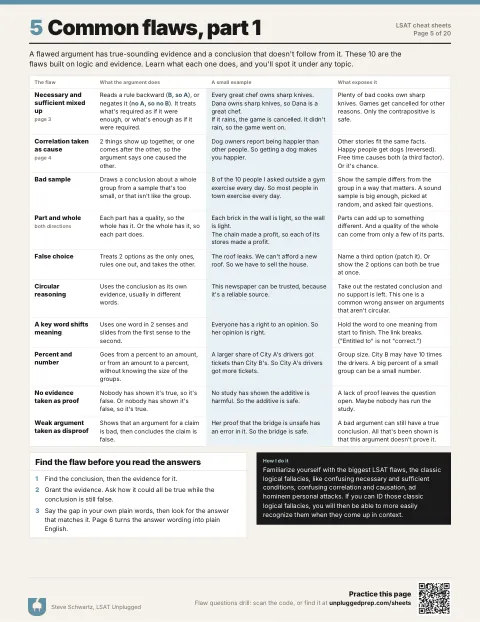
| Skeleton and costume | The same concept dressed up in a different disguise / The same patterns LSAC just recycles |
| The rule | What’s the biggest takeaway / What would you do differently on the next one of these |
| The forecast | Prephrase it / Where will this show up again |
| The rematch | Reviewing these on your own and retrying them would be good / I do think waiting a day or two would be good / Send me the ones you want to look at next time |
| The confidence audit | Tell me why you’d say C / Can you give me an example |
Use the book’s words in a notebook and the room’s words with a partner. If you keep only one set, keep the room’s, because those are the questions.
The tear-out page
Copy this onto one sheet and keep it next to your practice tests.
The Three Columns (step 3). One tally mark per troubled question, in the column where the point died.
| Stimulus | Stem | Choices |
|---|---|---|
The Eight Columns (step 5). Set up a spreadsheet or a notebook spread with these eight columns, one row per troubled question. An empty cell is the step you skipped.
- Question type
- Stimulus
- Stem
- Wrong answer: what made it tempting
- Wrong answer: what makes it wrong
- Right answer: what made it unappealing
- Right answer: what makes it correct
- My rule (one line, future tense, with a trigger)
The Check-In (test day, every question, about three seconds). What did I read? What’s the conclusion? What’s the method of reasoning?
How to get more help
Everything in this book runs on a pen and a page. If you want more, here’s what’s free, in the order I’d use it.
The companion workbook. Printable sheets, including a review page built on the six steps. unpluggedprep.com/books
The free LSAT cheat sheet. unpluggedprep.com/cheatsheet
The LSAT Unplugged YouTube channel. Free lessons, with plenty of misses worked out loud.
A free LSAT tutoring lesson. Bring your skeleton log and the next troubled question you want reviewed, and a coach who scored 170 or higher will run the right-hand column on it with you. unpluggedprep.com/start
If you’ve read Anyone Can Beat the LSAT
If you want the full LSAT plan around this method, Anyone Can Beat the LSAT is that book. Its chapter 6 is this book in miniature, and its free companion workbook holds the drill bank. Both books use the same six steps, so you can go back and forth between them.