Step 5, the forecast: "Where will this show up next?"
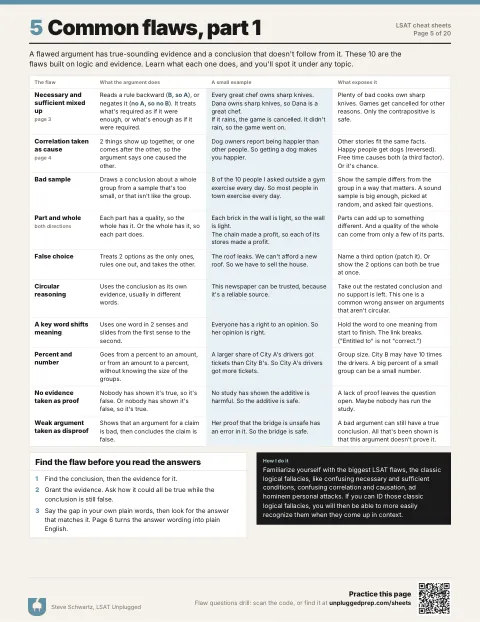
The LSAT isn’t allowed to change the bones. That’s the claim at the center of this method, and it’s why review works at all. A limited set of reasoning patterns, maybe a few dozen, gets reused across every administration, dressed in new subject matter each time. The pattern is the skeleton. The subject matter is the costume. Learn the costumes and you’ve learned something that will never appear again. Learn the skeletons and you’ve learned the test.
The way I put it to students:
“The method of reasoning might be the same even if the topic changes. So one exam that method of reasoning could be about heart attacks, another time it could be about climate change, another time it could be about dinosaur extinction. The topics may change, but the underlying methods of reasoning remain constant.”
Ben heard a version of this in his last session before his test, when he was worried that his reviews weren’t carrying over:
“It’s difficult to recognize the same concept when it’s dressed up in a different disguise, a different topic, or a different question type. One of the purposes of our discussions together is to help you identify the key takeaway in as general a format as possible.”
“Disguise” is my older word for costume. I’ve had a few:
“the LSAT keeps repeating itself in different guises, in different disguises, in different masks.”
The idea comes up in nearly every session, because that’s what review is for. I told Sofia, on a weaken question about reversed causation:
“The more familiarity you have with the different forms of arguments, and the same patterns that LSAC just recycles over and over, the more likely you are to spot it in context when it appears.”
This step is about learning to see through the costume, and then predicting the next one. It takes two skills. The first is abstraction, saying the flaw in words that have nothing to do with the subject. The second is refusing to be fooled by surface matches.
On the card. Step 5, the forecast. It shares 3 minutes with the rule in chapter 8. Output: one line on where this skeleton shows up next, and in what costume. Out loud: “Where will this show up again?”
Is this your broken step? Answer yes or no about your last few reviews.
- I can write the flaw in my last miss without using a single noun from the question.
- I’ve spotted the same skeleton in two of my misses on my own, even when the topics were different.
- I usually know what the right answer has to do before I read the choices.
If you said no twice, spend next week here. Start with “Your three questions, step 5 (the forecast)” at the end.
Abstract it out
Lucas, fourth session, a parallel flaw question. He’d picked a choice that seemed to fit and told me he didn’t like parallel flaws. Most students don’t, in my experience, because they treat them as matching puzzles and line up the nouns in the stimulus with the nouns in each choice. That’s costume matching. It loses points.
I started at the bones.
“All right, well, to start with, let’s make sure that we understand what is the flaw in this argument, right? Because if you know what the flaw is and you can abstract it out, like a general principle, as you would do for a regular parallel question, if you’re crystal clear on the flaw, it’s going to be easier to spot it.”
Once the flaw was stated in general terms, the choices stopped being five paragraphs. They became five candidates for one specific error. Then came the part he’d actually been missing.
“So then we come down to, what are the relevant differences and what are the irrelevant differences, right? And so whether it’s one person or another doesn’t get at the core of the flaw itself.”
He admitted that was his real problem. He couldn’t sort the relevant differences from the irrelevant ones. A choice that changed who the actor was looked different to him, but the flaw didn’t care who the actor was. A choice that changed what the actor knew was different in exactly the way the flaw cared about. Who is costume. What they knew is bone.
Marcus got the general rule in his very first session, also on a parallel flaw question:
“Read the stimulus, determine the flaw for yourself, be able to articulate the flaw in your own words, and then look for a choice exhibiting the same flaw. And when you’re looking at the choices, don’t compare the choices to each other. Compare them to the stimulus, or in this case, the flaw that we’ve articulated.”
He had a loose sense of the flaw and no general wording for it. When I asked whether he could describe it in general terms, the honest answer was no. So we built the wording first and went to the choices after. The choice he’d been leaning toward was there because of a hedge word that reminded him of the stimulus. One word of matching costume. I asked whether that was enough of a reason, and he said he’d get more specific.
Validity, not vocabulary
The second skill is harder, because the test baits you on purpose. Priya, first session, a parallel reasoning question. Not parallel flaw; in parallel reasoning the stimulus is a valid argument, and you need the choice that’s valid in the same way. She’d picked a choice under time because it used the same comparison words as the stimulus. Same costume, different bones.
I opened with the question most students never ask on these.
“Let’s get really clear just on the stimulus. Would you say this stimulus is valid?”
She worked through it. Yes, the reasoning held.
“Good, exactly. So the stimulus is solid reasoning. We need to be really clear on that. This is a parallel reasoning question, not parallel flaw.”
Then the choices. Her pick had the matching words, and when we tested its logic, it didn’t hold. I typed a quick number example in the chat to show that its conclusion could be false while its premises were true. The right answer used different words entirely, and its reasoning was airtight in the same way the stimulus was.
“The thing to focus on, instead of the matching, is just, okay, the stimulus is valid, B is valid, and they’re taking the same general route.”
She asked whether she should always check validity first. Yes.
“I would certainly look for validity. If something is flawed, you knock it out.”
That one check kills most wrong answers on parallel reasoning before any matching begins. Students skip it because it feels slow. Matching five choices on vocabulary is slower, and wrong.
A very small thing
Eli’s last session, the week of his test, a parallel flaw question. He’d been running the method for two months by then, and I wanted to watch it run without me. I set it up:
“If we don’t see the flaw, of course, we’re going to have a problem, right? So let’s make sure we can see first: what is the flaw in the stimulus? Identify that flaw, and then we’ll be better equipped to look for the same flaw appearing in a different context in the choices.”
He diagrammed it, and the first diagram was wrong because he’d included a term that was a distraction. He caught it, retyped the diagram, and named the flaw himself. The arguer had flipped a conditional without negating it, reversing without taking the contrapositive.
“Exactly. So they reversed without negating. So they did not properly take the contrapositive. It’s a very, very small thing that, of course, makes all the difference.”
Two months earlier this student had been picking choices by feel, on a section where he got eight to ten more right untimed than timed. Now he found a reversed conditional on his own and matched it in the choices. He’d met that skeleton before in other costumes. This time he recognized it.
Predict first
If I had to name the one thing I ask students to do most, it isn’t a review step. It’s to predict the answer before reading the choices. Some version of “prephrase,” “predict,” “anticipate,” or “before you look at the choices” comes up in about half my sessions. Nothing else I say comes close.
It belongs in a book about review because prediction is the review method running forward. Step five of the method asks you to write a forecast: where will this skeleton show up next, in what costume. Prephrasing is the same muscle pointed at the next question instead of the last one. You read the argument, say what the right answer has to do, and go find it. A student who can prephrase reliably has internalized the review. A student who can’t is still waiting for the choices to tell them what to think, and the choices are not on their side.
Ideally, for these
Theo, second session, a flaw question built on an analogy. I opened the way I open most flaw questions.
“Okay, so flaw question. Ideally for these, we want to read the stimulus and try to determine the flaw for ourselves before looking for a description of it in the choices. So when you read the stimulus, do you see any prephrase in mind for why the argument might be flawed?”
He said the argument made a big jump, and then that he couldn’t put it into words. That’s a weak prephrase, and a weak prephrase still counts. It points you at a choice that describes a gap between the two things being compared, and makes you suspicious of choices describing some other kind of flaw. We built it out together. An argument by analogy is only as good as the similarity, so the flaw would be about a difference the arguer ignored.
“Whenever you make an argument by analogy, if there’s some key difference between the two things you’re comparing, that can problematize the analogy. Just because they’re alike in one way doesn’t mean they’re alike in other ways.”
Later in the same question he picked a wrong choice, started explaining why it felt right, heard himself, and said he’d misread it. That’s the deposition catching a choice-level death. What I want you to take from this exchange, though, is the first ninety seconds. His prephrase was vague and unconfident, and it was still enough to start from. The students who struggle most with prediction won’t predict until they’re sure. You’re never sure, so they never do.
Where does the passage tell you what’s next?
Prediction isn’t only for Logical Reasoning. Naomi, first session, Reading Comprehension. We were talking about reading actively, and I asked her to predict as she read. She did something smart and slightly off, listing the kinds of questions she expected the passage to generate.
Good instinct. Wrong object. I redirected.
“The reason that we brought up reading comp today is because we’re looking for that prediction of sorts, right? So given that, do you see any indications of that in this passage? Where in the passage are they telling us what will come later in that very same passage? Not the passage predicting the questions, but rather the passage predicting itself.”
She went back and found it. The closing sentence of paragraph one set up what paragraph two would have to do. She described paragraph two before reading it, and she was right.
That’s prephrasing a passage. Most passages announce their own structure, and a passage that does hands you the main point and the organization before you’ve finished the first paragraph. A student who catches the setup reads the rest checking a prediction. A student who doesn’t reads it collecting details, then meets a main-point question with a pile of details and no point.
The cost of not predicting
Reading the choices first is slower, and nobody tells you that. It feels faster because you skip the thinking step, but you don’t skip it. You do it five times, once per choice, with the choice in your ear the whole time. A student with a prephrase reads five choices against one standard. A student without one reads five choices against each other, which is the trap from chapter 5, and then runs out of time on the next question.
Kevin came to me wanting a 180 and struggling with a specific pair of question types. By his second session he’d written himself a prediction rule out of a review we’d done. Identify the conclusion first, find the new piece in it that the evidence never mentioned, then look for the choice that ties that piece back to the evidence. That’s a prephrase for every necessary assumption question he’ll ever see, and he wrote it after missing one. Two months later he was scoring in the mid to high 170s and telling me the question type he’d been scared of was his favorite.
Training the prediction
When I walk a miss, my second question after “why did you pick it” is “what was your prediction before you read the choices?” The most common honest answer is that there wasn’t one. That’s the root cause under more misses than any flaw type. When students ask how to train the prediction itself, I tell them:
“There’s no big secret to predicting the answers on the LSAT. You don’t have to be like Neo in the Matrix to be able to see through anything. It’s really just a matter of exposure. Top scorers have more context, more familiarity, more background, so that when they see a new question, they’re not trying to reason through it under timed conditions. They’re pattern matching to what they’ve seen in the past.”
Exposure, with review attached. A student who’s run the why-chain on forty misses has forty skeletons in a notebook, and the prephrase is what it feels like to recognize one before the choices get a vote.
Writing the forecast
Step five ends with a one-line forecast of where this skeleton shows up next, and in what costume. Students skip it more than any other step because it feels like fortune-telling. It’s pattern recognition with a date on it.
Each student in this chapter was learning to write forecasts out loud. Lucas learned that “who” is costume and “what they knew” is bone, so the next parallel flaw will change the actor and keep the error. Priya learned that matching words are bait. Her forecast is that the next parallel reasoning question will have a wrong choice that sounds like the stimulus and a right one that doesn’t. For Marcus, the next time one word in a choice feels familiar, that’s the test setting a hook.
None of those forecasts names a question. All three will come true.
The fake version
The fake forecast names a topic. “Watch out for the next one about climate change.” That’s the Costume Rule showing up a step early, and it can’t come true, because that costume won’t appear again. Name the error and leave the subject blank. Chapter 8 has the rest of the Costume Rule.
In your notebook
Under every rule you write, add one line headed “Next costume.” Put the skeleton first, in plain words, then the outfit you expect it to wear next. Using the forecasts from this chapter, Lucas’s line would say the next parallel flaw keeps the error and changes the actor. Priya’s would say a wrong choice will sound like the stimulus.
When a later question matches one of your forecasts, put a tally mark next to it. Each mark is proof the forecast was about bones. Chapter 9 turns those marks into a log.
Your three questions, step 5 (the forecast)
Go back to the three troubled questions you picked in step 1. Each one has a deposition, a rebuild, and a circle by now, and the worst one has a root cause from step 4. For each of the three, write the flaw or the gap in one sentence with no nouns from the question in it. “Treats a sufficient condition as necessary.” “Assumes one cause when there could be another.” “Shifts from most to all between evidence and conclusion.” If you can’t write the sentence without the subject matter, you haven’t found the bone yet. You’ve described the costume.
Under each sentence, write the forecast. Say which kinds of questions this skeleton will turn up in next and what sort of costume it’ll wear. Leave the topic out.
Then look at the three sentences together. If two are the same sentence, you’ve found a skeleton that’s been taking your points in two different outfits, and your forecast writes itself. If you want more data, run the same one-sentence test on your last five Logical Reasoning misses, any type.
For extra credit, go back to the wrong choices that didn’t fool you and ask what makes each one tempting to somebody:
“Of course, not every wrong answer choice will be tempting, but a lot of them will. And even if it wasn’t tempting to you, it might be interesting to see if you could figure out why that might have tripped up someone else. Because although it didn’t trip you up this time, it might trip you up in the future in a different context.”