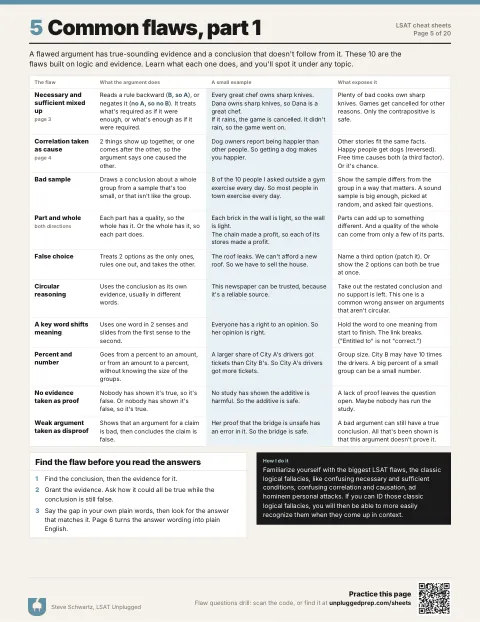
Step 4, the why-chain: "Does that need to be the case?"
On paper, this step asks why that answer felt safe.
This is the engine, the step that makes careful review Socratic. The deposition gets you one honest sentence about what you believed when you clicked. The why-chain takes that sentence and asks why, then why again, and keeps going until the answer stops being about this question and starts being about how you think arguments work.
The why-chain has a floor of three whys, because the first answer is always a symptom (“I rushed”) and rushing is never the bottom. It also has a stop test. You’ve hit root cause when two things are true: the answer is a belief about how arguments work, not a fact about this question, and it would explain other misses too.
On the card. Step 4, the why-chain, 8 minutes. You ask why that answer felt safe, then why again, three times at least. You stop when the answer passes the stop test.
Is this your broken step? Answer for the last miss you reviewed, not your best one.
- My review of a miss goes at least three whys deep.
- It ends on a belief about how arguments work, not on “be more careful” or “I rushed.”
- I keep a written list of the traps I fall for, and I read it before a timed section.
Say no twice and this chapter is your week. Its exercise is the last thing in it.
In the room, the why-chain rarely uses the word “why.” It sounds like a question I ask so often that students start hearing it in their sleep.
“Does that need to be the case?”
The idea underneath it, the difference between what an argument requires and what merely helps it, comes up in close to half the assumption questions I work through with students. It’s the first link of a why-chain. The moment a student answers no, it doesn’t need to be, the next question is why they thought it did.
Too extreme
Ben, fourth session, a necessary assumption question. He’d picked a choice that made a strong, sweeping claim, because it seemed like it had to be true for the argument to work. A necessary assumption question asks for something the argument can’t live without, so the instinct was right. He’d aimed it at the biggest claim on the screen instead of the smallest claim the argument can’t do without. It’s one of the most common ways to miss this question type.
I didn’t say “that’s too strong.” I asked whether the argument could survive without it.
“Does that need to be the case?”
He thought about it. I pushed on the specific version: what if the claim were only partly true, or true in most cases but not all?
“Is that possible? Would that be okay?”
He worked through it out loud and landed on yes, that would still be okay. The argument only needed a much more modest version, and the modest version was sitting in another choice.
“That’s the problem. It’s too extreme.”
Now the why-chain. Why had the extreme choice felt safe? Because it seemed like it had to be true. Why had that pointed him at the strongest choice? Because he’d been reading what the argument needs as what would make the argument work for sure. Those are different things. What an argument needs is the smallest claim that, taken away, makes the argument fall apart. What makes it work for sure is a guarantee, and a guarantee is usually a much bigger claim. He’d been hunting for the guarantee on a question that asked for the need. (The test calls the guarantee a sufficient assumption and the need a necessary assumption, and it asks for each by name.) There was a groan, and then he said it made sense now.
That passes the stop test. It’s a belief about arguments, and it explains other misses: every necessary assumption question where he’d been drawn to the strong choice, and every sufficient assumption question where he’d been scared off by one.
Two months later the same question worked on a different student. Kevin, second session, had picked a choice on a necessary assumption question because the comparison in the argument only worked, as he saw it, if two things were equal. The choice made them equal. What he’d found was something that helped.
“Well, let’s think about necessary assumption, right? Does it need to be the case? It strengthens the argument, but our question is, is it required.”
What if the two things were a little unequal? Could the argument still work? They worked it through and saw that it could. The stem had asked for what the argument couldn’t live without, and that was a different choice with more moderate language.
“With necessary assumption questions, all else being equal, we want to gravitate towards more moderate language, because more moderate language is more likely to have been required by the stimulus than more extreme language would be.”
Both students had confused “would help” with “is required.” If either of them had written the why-chain on paper, the third why would have landed there.
What root cause sounds like out loud
Here’s me describing root cause itself to a student. I think it’s the clearest thing I’ve said about why review works when it works.
Daniel came to me after studying for over a year, with sections at zero or one wrong, and a real test that had gone badly. Near the end of our first session he told me he’d hit a wall. He’d understand a miss completely, and months later he’d miss the same kind of question again. He wanted to know what he was doing wrong.
“If you’re reviewing a question, you understand it, and then you get it wrong months later, it means that first off, you’re not remembering the question, but secondly, you’re not remembering the lesson learned from having reviewed that question. So we want to get beyond just ‘this is A versus D,’ but rather we want to look at what is the mistake in your thought process that is habitual, that leads you to consistently choose that tempting wrong answer.”
That’s the stop test, said to a person. A habit of thought that would explain other misses. And then the reason it has to go deep:
“You want to analyze the error in sufficient depth so that the recognition of the error goes from your short-term working memory into your long-term memory, so that you will never make that same mistake again.”
He’d been reviewing the questions for a year. He hadn’t been reviewing himself. I gave him the written framework that night, and the next week he came back having run it on a week of flagged questions and missed none of them. Four weeks later, after a lot more work, he posted a 180 and a 176 on practice tests. He told me what had helped was one idea he’d pulled out of the reviews. Every one of these argument questions turns on a single assumption, and the job is to find it. It’s a rule about arguments, which is what a month of root causes adds up to.
Sidebar: “My explanation already told me why.”
It told you why the right answer is right. It can’t tell you why you picked the wrong one, because it never saw what you were thinking. Daniel had a year of explanations behind him and still made the same misses. The why-chain starts from your sentence, and no explanation has that.
The log of your own tricks and traps
The why-chain produces root causes one at a time. Over weeks they pile up, and a student who writes them down ends up with something I ask for in a lot of first sessions. Ben got the clearest version:
“What are the tricks and traps that you’re uniquely prone to falling for? What are the concepts that you are not totally clear on? You want to keep a log or a journal of sorts documenting that. Then when you go into a new section, you don’t need to actively think about everything. You just need to think about your things.”
“Uniquely prone to” is the phrase I’d underline. In my experience the test has a few dozen ways to be wrong, and any given student falls for four or five of them over and over. The why-chain finds yours, and the log keeps them. It works under time, when nothing else does, because you walk into a section carrying a short list instead of a textbook.
In a session, I skip the name and ask the question that produces a root cause. “Does that need to be the case” is the first why with the word “why” taken out. The student answers no, and the belief that made them say yes is now on the table, where the next why can get at it.
In this book it’s called the log of tricks and traps, and it’s what this step leaves on paper. Each entry is two lines, the trap and your rule, in your words. Here are two, from Ben and Sofia.
| The trap | My rule |
|---|---|
| On necessary assumption, I grab the biggest claim because big feels required. (Ben) | Ask whether the argument could survive without it. Lean toward the modest choice. |
| I read past one adjective, and it was the word that made the jump a jump. (Sofia) | Read every modifier in the stimulus. One word can turn a fair claim into an extreme one. |
Before a timed section, read the log. It should fit on one page. If it doesn’t, some entries are facts about single questions. Run the chain on those again.
Walk me through the negation
The why-chain’s most reliable tool on assumption questions is the negation test. Flip the choice to its opposite and read the argument again. If the argument falls apart, it needed that choice. If it’s fine, it didn’t. I’d rather the student run it than watch me run it. Theo, fourth session, a necessary assumption question. He’d swapped between choices a few times. I gave him the setup:
“You don’t need to have a specific prediction here, but I’d be looking for a general prediction. And when you see your chosen answer, pick it, let me know. And then as an exercise, we can walk through negating each of the choices.”
He picked. I tested the tempting one with this chapter’s question:
“But does it need to be the case that they do it exactly once in order for this test to work? Or could they do it at some other frequency?”
He reasoned out loud that it didn’t need to be exactly once, and the choice was out. Later in the session came the part I’d set up:
“Walk me through what the negation of that would look like and why that choice works.”
He negated his chosen answer correctly and explained that the negation would destroy the argument. The student ran the test. I only asked questions. “Does it need to be the case” is “why did that feel safe” pointed at a single answer, and the negation checks the answer instead of taking it on faith.
Which half of the test is failing?
Sometimes the negation test doesn’t help. When a student tells me that, I ask which half is broken. Ben, third session, said negating never made the conclusion look wrong.
“Are you having difficulty with negation, or when you negate, you’re still not seeing how it problematizes the argument?”
The second one, he said. The negation was fine and the problem came after it. He’d flip the choice and couldn’t see what the flipped version broke, and you can’t see what breaks in an argument unless you know its parts. That told me the rebuild wasn’t solid.
“So let’s take a look at the answer here, and then let’s negate it, and then see what impact does that have. So now let’s look at the stimulus, and what’s the conclusion? What’s the evidence?”
He negated the choice, named the conclusion and evidence, and saw what the negation cut. Two lines of rebuild fixed the negation test. The why-chain asked one why and landed on a different part of the method, which is normal. The six steps work more like a set of questions than a sequence, and when one gets stuck, it’s usually because an earlier one got skipped.
What’s the burden of proof?
The deepest root cause in the assumption family sits between necessary and sufficient. Sofia hit it in her seventh session on a sufficient assumption question, across three attempts at the same question. On one of them she’d taken a choice that closed a gap the argument needed closed.
“That’s exactly right. So you’re seeing something there. So choice B is a necessary assumption, but it’s not a sufficient assumption, and our task with this question is sufficient.”
Then the question I think states the root cause under both question types most clearly:
“So, sufficient assumption. What is the burden of proof? What is the standard that we need to reach in order to show that something is in fact correct? Sufficient assumptions have to guarantee the conclusion.”
She’d picked something the argument needed. The stem asked for something that would guarantee it. Those are different standards. A student who’s mixed them up misses both question types in opposite directions. On necessary questions they grab the big claim, because big feels like needed. On sufficient questions they grab the small claim the argument needs, which isn’t enough to guarantee anything. Sort the misses by question type and you see nothing, because one belief is spread across two piles. The pattern only shows at the level of the belief, “if the argument needs it, it’s the answer.” Three whys down, that’s the bedrock, and once it’s named it stops working on you.
“Just always remember the question type.”
I say that sentence a lot, and it sounds trivial until you’ve watched what happens to a student who forgets it. Hannah reframed a stem and forgot to go back. Sofia answered a sufficient question with a necessary standard. Lucas was told to find what must be false and went looking for what must be true. The question type sets the standard. Lose the stem and you’re grading choices against a rule the test never set.
Why more than once
Half of the habit of asking why more than once comes from Socrates. The other half comes from a car factory. When a part broke on Toyota’s line, the engineers didn’t stop at the first cause:
“They keep asking why again and again and again until they can reach all the way back to find the root cause.”
Walk a broken part back and you pass a missed inspection, a rushed inspector, a quarterly target, and finally an order from the top. The point I take from that is the point of this chapter.
“So the insight here is it’s not about the one incident. It’s about tracing it all the way back to the root cause that would address incidents, all incidents of that kind.”
Business people know it as the five whys:
“I derived this from, for those of you familiar with business, the five whys, Kaizen, Six Sigma. If you haven’t heard of any of those, don’t worry. The idea is getting to the root cause of a problem. To keep asking why. To keep asking why you got something wrong, to keep asking why you had trouble with something, to figure out where your misunderstanding stemmed from.”
Toyota says five. I say three. The number matters less than the floor, and the floor is three because the first two answers are symptoms. Here’s a full chain on an invented miss, so you can hear what the bottom sounds like:
“You start with one question that you missed or you were unsure on, and you write the outcome in one line. For example, I chose B. The answer was E. Now you ask why. Because I thought B connected the premise to the conclusion. Why did I think that? Because the wording sounded like a bridge. Why did the wording fool me? Because I didn’t state what the right answer had to do before I read the choices. Why didn’t I state it? Because I felt rushed and I skipped the paraphrase. Why did I feel rushed? Because I was behind at minute twenty and I tried to make up the time on a hard question. So notice what just happened here. In five short whys, you moved from a vague mistake to a specific, fixable behavior: skipping the paraphrase under time pressure. That is not a concept problem. That is a process problem, and that process is trainable.”
The Reading Comprehension version ends exactly where the stop test says it should, on a belief:
“Why did you accept restatement? Because you didn’t label the sentence’s job while you were reading. Why didn’t you label it? Because you were trying to remember details instead of roles. Why were you doing that? Because you thought reading comp is about memory. Why did you think that? Because that’s how you were taught in school. The root cause: you’re reading for facts instead of roles.”
Where the chain can’t stop
The chain is never allowed to stop at “careless”:
“There’s no such thing as a careless mistake on the LSAT, because there is a miss in your process hiding behind those words. Careless means I didn’t paraphrase, or I chose based on content, not role, or I exceeded forty-five seconds and refused to skip the question. Name the process until you can fix it. If you just call it careless, it will keep coming back to bite you.”
“I need to slow down” and “I misread it” are the same kind of answer. I’ve called them emotional band-aids, and I stand by that. The chain goes through them.
“Out of scope” is the other early stop. Every wrong choice was written to tempt somebody, and it’s a matter of respect to find out who and why:
“To write off a choice as being wrong simply because it is out of scope is a cop-out.”
“And so even if I might not have been tempted by a particular answer choice, it’s reasonable to think that somebody would have been tempted by that choice.”
Ask what made the choice look in scope, and keep going.
The dead ends. The chain goes through every one of these.
- The Band-Aid. “Be more careful.” “I rushed.” “Careless.” Name the process that broke, like skipping the paraphrase or choosing on content instead of role.
- “Slow down” and “I misread it.” Ask which word you misread, and why your eye skipped it.
- “Out of scope.” Ask what made the choice look in scope, and who it was written to tempt.
The fake version
You met this step’s fake just above, the Band-Aid. You ask why once, write “I rushed,” and file it as a root cause. The floor of three whys is there to stop exactly that.
In your notebook
On paper, write the belief, ask why, write that, ask why, three times minimum, and stop when the sentence is about arguments and would explain other misses. For the live version without a coach, borrow this chapter’s question. For any choice you picked or kept, ask “does that need to be the case?” and refuse “it seemed right” as an answer. Then ask why it seemed right. The belief underneath turns up in two or three steps, and it’ll be one you’ve carried into every argument for months.
When the chain passes the stop test, copy the bottom line into your log of tricks and traps as two lines, the trap and the rule.
Your three questions, step 4
This time, pick the worst of your three. That’s the one whose deposition was ugliest, or the one where you wrote that you didn’t know why you picked it. Run the why-chain on it in writing, starting from your deposition sentence. Three whys at least. When you think you’ve hit bottom, check it against the stop test. Is it a belief about how arguments work? Would it explain other misses? If either answer is no, ask why again.
Then look at the other two. If the same belief explains one of them, you’ve found a skeleton, and you have your first entry for the log of tricks and traps. If it doesn’t, run the chain on the second-worst too.
Ben’s groan in his fourth session is what this step sounds like when it works. A belief he’d carried into every necessary assumption question came up where he could see it. No timed section was ever going to do that for him.
Drilling measures you. Review changes you.