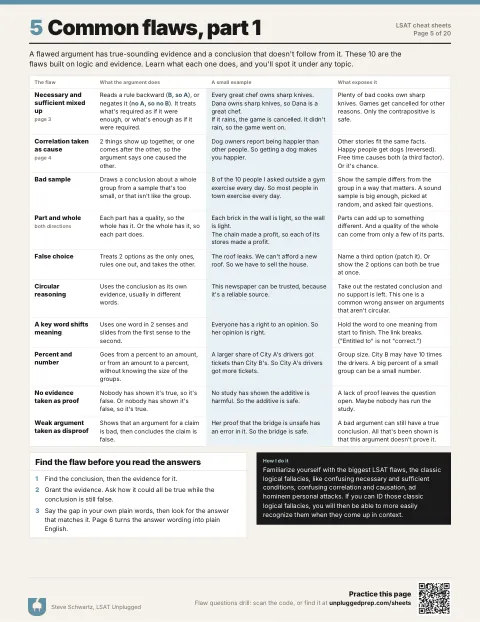
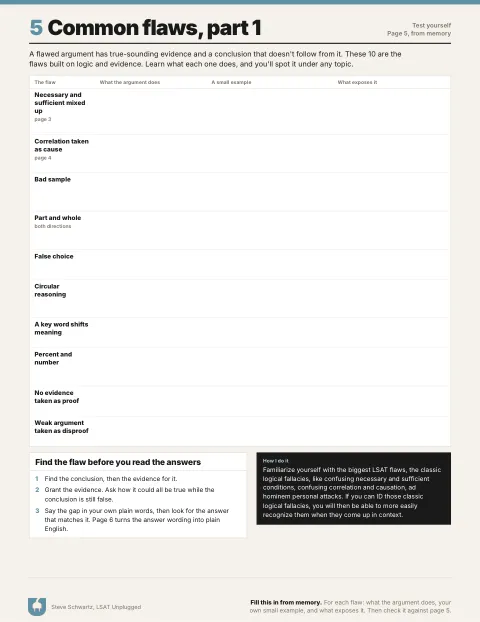
Step 3, where the point died: "Stimulus, stem, or choices?"
Every miss dies in one of three places. Maybe you misread the stimulus or never saw its structure. Maybe you answered a question the stem never asked. Or you understood everything and the choices seduced you anyway. Circle one every time, and in a few weeks the circles add up to a map.
On the card. Step 3, where the point died, 2 minutes. You circle one place, stimulus, stem, or choices, and add a tally mark to that column.
Is this your broken step? Yes or no, no partial credit.
- I can say whether a miss died in the stimulus, the stem, or the choices.
- I’ve tracked where my misses die across more than ten questions.
- One column on my page is clearly bigger than the other two, and I know which.
With two “no” answers, start here next week and finish on the exercise at the end.
I’ve asked students that three-way question for years:
“We’re looking to get to the root of what gave you trouble about a problem. So taking Logical Reasoning, for example, what led to your mistakes? Was it an issue with the stimulus, was it the question stem, or was it the choices?”
In the room, I don’t ask students to circle anything. I ask where it went wrong, and then we go look at the spot together. The first three exchanges in this chapter cover one place each, and all three come from the same student over four weeks. Hannah was the student with the canceled scores from chapter 4. Her misses died in all three places at different times, and over six weeks her practice scores went from the low 160s to a 174.
The stimulus: “let’s slow down”
Fourth session. A necessary assumption question built on a method of reasoning she hadn’t seen often, the kind where the numbers run in a direction your gut says they shouldn’t. She’d narrowed to two choices fast, which felt like progress, and then something nagged at her.
I could have walked the two choices. Instead I went backward.
“Well, let’s slow down, then. Look at the stimulus text.”
She reread it, did a visible double take, and said the thing I’d been hoping to hear for a month. The problem wasn’t the choices. She’d never been solid on what the stimulus was doing, and she’d gone to the choices anyway. Once you’re in the choices without a grip on the argument, you’re guessing with extra steps. She put it more strongly than I would have. If she went to the answer choices without being rock solid on the stimulus, she was finished.
“That’s why I wanted to focus here and just slow it down, because some of these counterintuitive or less obvious methods of reasoning can throw us off.”
That’s a stimulus death, and the fix is a reading rule. When the prephrase won’t come, the stimulus isn’t understood yet, and the only legal next step is back. Afterward she asked if there was a drill for this question type. I told her it wasn’t the question type. It was the method of reasoning, and you get better at unusual methods of reasoning by slowing down when they appear, which is exactly what she’d just done.
Misreads are the most common death by a wide margin. I told Ben in his first session what I’d tell anyone:
“When you’re analyzing a question and you get it wrong, it could be because you misunderstood something confusing in the stimulus. That’s what most often happens.”
The stem: the reframe you forgot to undo
Third session, a week earlier. Hannah brought a strengthen question she’d reviewed about a dozen times, by her own count. She was sure she’d misidentified the conclusion. She hadn’t.
“You’re right. That is the conclusion. So you’re not wrong about that. The question is, what is this person failing to consider? Let’s ask that. Or what are they assuming? In other words, what’s the gap?”
She’d done something smart, and it cost her the point. The natural way to find a gap is to flip the question around. Instead of “how do I strengthen this,” ask “what would explain the thing the arguer doesn’t explain.” That’s a resolve-the-paradox frame, and it’s a good tool for finding the gap. The trouble was that she then answered the reframed question. She found a choice that explained the discrepancy, and the stem had asked her to strengthen.
“It’s a strengthen question, but I can very easily see how you can reframe it to be resolve.”
The point died at the stem. She understood the stimulus and the choices and answered a question nobody had asked. When she saw it, she said she needed to flip it back, which is the rule:
“You need to always remember, of course, what’s the question they’re asking. If you reframe it for a moment, we then have to go back.”
Reframing is a real technique and I teach it. The failure is invisible from inside, which is why it’s worth naming. Once you’ve reframed, the new question feels like the question, and nothing in your head flags the swap. The only protection is rereading the stem before you commit. That habit gets built by dying at the stem a few times with somebody there to point at the spot.
The same death hides in assumption questions. On a necessary assumption question, the tempting wrong choice is often a sufficient assumption:
“So it is the right answer to the wrong question.”
That miss shows up in the choices, but it died at the stem. Circle the stem, or you’ll fix the wrong thing.
The choices: not against each other, ever
Second session. Hannah asked what to do when two Reading Comprehension choices are so close they can’t pick. It’s the question I get most about the section, and my answer hasn’t changed in twenty years.
“Go back to the passage text, because you don’t want to compare them against each other. That’s an easy trap to fall into. I would check them instead against the stimulus.”
She asked whether that meant never against each other, on every section. Yes. Ever is the right word. When you compare two choices to each other, you’re asking which one is better, and the test is built to make the wrong one look better in exactly the ways you’re prone to notice. When you compare each choice to the text, you’re asking which one is supported. That question has an answer.
Daniel got the longer version in a different month. He was overthinking between two choices on the first question of a passage, draining time, and wanted a way to be more definitive. I told him there’s no trick, and then I told him where the trap usually is.
“Of course you don’t want to fall into the trap of comparing them against each other. I would always just compare each one independently back to the passage, and in Logical Reasoning back to the stimulus. They’re really tricky about that. Usually they’ll make it that the first half is good but the second half is off in some way.”
That last line describes how wrong choices are built. The first half earns your trust. The second half spends it. A student comparing two choices to each other sees two good first halves and starts weighing vibes. A student comparing each choice to the text reads the second half, finds nothing on the page for it, and is done.
“The LSAT is too clever for that sort of thing. Other exams, there are little tricks. Reading carefully, reading fully, looking critically at every single word.”
The way I name the two kinds of trap:
“So you have traps of discouragement pushing you away from the right answer, and you have traps of encouragement luring you towards the wrong answer.”
One adjective
More stimulus deaths, because they’re the most common and the most fixable. Sofia, eighth session, a flaw question. She’d cut to two choices and found one answer’s wording hard to accept. We worked out that the flaw was a jump to an extreme, and then she said the thing that made the exchange worth it. She’d skipped one descriptive word in the stimulus, and that word was what made the arguer’s jump a jump. That one adjective, she said, changed the whole stimulus. I agreed that it could.
Her rule, written on the spot, was to read adjectives carefully. It sounds too small to be a rule. On this test, though, a single modifier can turn a reasonable claim into an extreme one, or a general claim into a narrow one. The student who reads for nouns and verbs ends up with a perfect rebuild of the wrong argument.
Wrong choices are often this close:
“And so it may be that a choice is 75 or 80% good, but then there’s one or two key words at the end of the answer choice that ultimately make it wrong.”
I’d given Sofia the general warning two sessions earlier, on a different question:
“With flaw questions, the wrong answer will always be wrong just because it’s accusing the argument of doing something it hasn’t done.”
And the companion warning, about what students do when a choice almost fits:
“That’s a common issue where students force it to support a choice and try to squeeze it to make it work. Ideally with flaw questions you go in already with a prephrase in mind for what the flaw is.”
Squeezing is a choice-level death with a stimulus-level cause. The student squeezes because the prephrase was off, and the prephrase was off because one adjective got skipped. Circle “stimulus.”
The opposite of what it said
The most dramatic stimulus death I’ve seen was Daniel’s, in his fifth session. He’d read a stimulus as saying the opposite of what it said. Not a shade off. The reverse. And he’d reasoned flawlessly from the reversed reading to a wrong answer, which is why this kind of miss is so hard to catch alone. Every step after the first is correct.
I said, carefully, that he may have misread the stimulus, and we reread it together. He saw it. Then he said something I think every strong student feels and few say out loud. He worried that he interpreted questions his own way.
Everyone does. Keep interpreting, and check the interpretation against the words before you commit. That’s pointing to the text again, from chapter 4.
The time qualifier
Eli, seventh session. He’d disqualified a choice for a feature the claim had never limited. I asked whether that was really why:
“Are you saying you’re disqualifying it because it’s about that one thing?”
He was. We looked at the claim, and it covered any instance of the thing, not just the one he’d fixed on. Then he saw the actual issue, a time qualifier in the choice he’d read past. Two misreads stacked. First he added a limit the stimulus didn’t have, then he dropped a limit the choice did have. Both come from one skeleton, reading what you expect instead of what’s written.
What the circles told us
Hannah’s four weeks produced three deaths, each with its own fix.
If I’d given Hannah one rule for “getting more questions right,” it would have been wrong two-thirds of the time, because her misses weren’t one kind of miss. That’s the whole argument for circling. A student who’s logged twenty misses and finds fifteen circles on “stimulus” has learned something no explanation of a single question could teach. They need to read slower, and nothing else is as urgent. A student with fifteen circles on “choices” needs the opposite fix.
Once the map exists, the student starts reading it themselves. By her sixth session Hannah was bringing me the missed question plus her own guess at where it died, and she was usually right.
For students stuck in the high 160s, the stimulus column is usually the one to watch. I tell them:
“Don’t ask what type they were. Ask how many times you read the stimulus, the argument. If you only read it once, that might be the issue. The thing that decided whether you got it right or wrong happened twenty seconds before you ever reached the choices. It was a reading failure back in the stimulus.”
Most students review the choices because that’s where the wrong click happened. The click is the last step of a miss that usually began a paragraph earlier, and the Three Columns, below, are how you find which paragraph.
The fake version
Faking it means circling “choices” every time. Hannah reviewed one strengthen question about a dozen times, sure she’d botched the conclusion. The point had died at the stem, and a dozen reviews in the wrong column never found it.
In your notebook
Three columns, one page: stimulus, stem, choices. Every troubled question gets one tally mark. After ten questions, look at the page. If the stimulus column is winning, your fix is the third line from chapter 4 and reading slower on the first pass. If the stem column is winning, reread the question before every commit, especially after any reframe. If the choices column is winning, you’re comparing choices to each other. Stop, every time, and compare each one to the text instead. Most students have one column that’s twice the other two. That column is your next month.
Call that page the Three Columns. Here’s Hannah’s, from the four weeks in this chapter, one tally per miss.
| Stimulus | Stem | Choices |
|---|---|---|
| I (session four: an unusual method of reasoning; she went to the choices without a grip on the argument) | I (session three: reframed a strengthen question as resolve, then answered the reframe) | I (session two: two Reading Comprehension choices so close she couldn’t pick, and the pull to weigh them against each other) |
Three marks, one per column, and the page already rules out one fix for everything. Yours will get longer, and one column will pull ahead.
Your three questions, step 3
Now circle where the point died on each of your three. Your rebuild from step 2 decides it. Shaky evidence and conclusion lines mean the stimulus. A clean rebuild plus an answer to a question nobody asked means the stem. If you understood both and still got pulled, it’s the choices.
Then put three tally marks on a fresh Three Columns page. Three marks aren’t a map yet. Every troubled question from here on gets a mark, and after ten, look for the tall column.