Step 2, the rebuild: "What's the conclusion? What's the evidence?"
This is the rebuild. Three lines on paper: what’s the evidence, what’s the conclusion, and, for every choice you keep alive, the words from the text that support it. Do a bad job of the first two, on purpose, because a clumsy rebuild that’s honestly yours is worth more than a polished one copied off the page. And if you can’t pull evidence and conclusion apart at all, you’ve found the problem, which beats finding an answer.
On the card. Step 2, the rebuild, 3 minutes. You write two lines, evidence and conclusion, in your own words, badly. Then a third line for every choice you kept alive, with the words from the text that support it.
Is this your broken step? Score yourself on your last real miss.
- On a miss, I can write the evidence and the conclusion in my own words before I look at the choices.
- I can name the word in the conclusion that never shows up in the evidence.
- For every choice I keep, I can point to the words on the page that support it.
Two “no” answers put you in this chapter for a week, with the step 2 exercise at the end.
In the room, the rebuild is two questions, and I ask them in a row, fast, like they’re one question.
“What’s the conclusion? What’s the evidence?”
Consequently
Hannah arrived carrying two canceled scores and a study schedule of eight to twelve hours a day. In the first session we looked at a sufficient assumption question with a chain of conditional statements in it. She’d been over-diagramming everything, and the diagram hadn’t saved her.
I left the diagram alone and started with the two lines.
“Okay, perfect. So I would look at here, what’s the conclusion? What’s the evidence?”
She found the indicator word. The sentence that started with “consequently” was the conclusion, and she said so.
“Consequently, perfect. That’s your conclusion indicator.”
Then she did something I stopped to praise, because it’s the actual skill. The evidence used one phrase and the conclusion used a different phrase for the same idea, and she matched them.
“That’s really great, what you did, because what you’re doing here is you’re recognizing that even though they’re not using the exact same words, the concept is the same. So you marry the variable of the conclusion to the necessary condition of the evidence, which is key.”
With the two lines in place, she could see where the chain was open, and she could explain why the wrong choice had attracted her: it was the contrapositive of a piece she needed, which is a very specific way to be wrong. Three sessions earlier she’d have drawn six arrows and picked based on which one looked tidiest. The rebuild didn’t make the question easy, but it made it legible.
Evidence, conclusion, sub-conclusion, filler
The rebuild gets harder when the argument has more than two parts, and the test knows it. Marcus, in our last session, brought a role-of-a-statement question. He’d picked the choice that called a certain claim the only conclusion in the argument instead of the one that called it the main conclusion among others. His reason was honest: a sentence in the middle of the stimulus had looked like it might be a second conclusion, so he’d gone the other way.
So we rebuilt the whole thing, sentence by sentence.
“The question then is, what would have been the other conclusion? Would there have been a sub-conclusion somewhere in the argument? Did you see anything that looked like a sub-conclusion?”
He pointed at the first sentence. I asked him to classify it.
“What is that? Is that evidence, conclusion, sub-conclusion, filler? What role does that play?”
He said: background information. Right.
“So background, not core to the argument, nothing is supporting it. It’s just established to give you context.”
Then he asked a question I wish every student would ask. Would a real sub-conclusion have its own evidence supporting it? Yes. That’s exactly what makes it a sub-conclusion rather than a premise. Something supports it, and it in turn supports something else. He walked out with a rule he’d written himself: for any sentence that might be a conclusion, check whether something in the argument supports it, and check whether it supports something further. If the answer to the first is no, it’s a premise or background. If the answer to the second is no, it’s the main conclusion.
That rule is about how arguments are built in general, which makes it a root cause in the sense of chapter 6, and he found it with four questions and no explanation of the stimulus at all.
One sentence
The purest form of the rebuild is also the shortest. Claire, in her last session before her test, was torn on a main-conclusion question. She’d rejected the right choice because it didn’t cover everything the argument said. So I asked her to shrink the stimulus.
“If you could leave this stimulus with only one sentence, what would that sentence be?”
She gave me a sentence. I asked where it showed up in the stimulus, and she found it. Then we went to the choice she’d rejected.
“Does the main conclusion need to give the full story of the argument?”
No. That was the error. She’d been grading the choice on completeness, as if a conclusion had to summarize its own evidence. The other choice she’d been considering turned out to be a supporting reason for the first, which she saw as soon as she stopped asking which sentence said more and started asking which sentence the others were there to support.
“A conclusion question does not need to include the entire stimulus, right?”
Later in the same session she pushed back on me about the structure of a different argument. She had a reading in which the sentences supported each other in a different order than I’d proposed, and she defended it. I called it our debate instead of ruling, and tested both readings against the indicator words, and against the one-sentence question: what’s the single point the author would leave you with. She ended by restating how the other sentences fed the first. A week out from the test, arguing structure with me instead of asking me for it, is exactly what the rebuild is supposed to produce.
What keywords do we have there?
Sometimes the rebuild stalls because the student has started drawing before reading. Lucas, fifth session, a question about the role of a statement in an argument. He’d picked wrong and had started diagramming the moment he saw conditional language. I stopped the diagram and asked about words.
“So in the stimulus, what keyword do we have? I mean, do you see any keywords in that first sentence?”
He found one. It was a necessary-condition indicator.
“Good. Because that’s a necessary indicator, right? So it’s a background kind of thing, meaning evidence. It’s telling us that we assume this to be the case. So that means that this is not going to be the conclusion, because they’re saying already, assume this is true.”
That settled it. The opening sentence was introduced as a given. A given can’t be a conclusion; nobody argues for what they’ve asked you to assume. He said he hadn’t registered that it was given. He’d been so ready to diagram the conditional that he’d skipped the word in front of it that told him what role the sentence played.
“Use those indicator words to help orient where we’re at. I understand the temptation to diagram.”
The rebuild is reading before it’s drawing. Evidence and conclusion are marked, most of the time, by words that tell you which is which, and a student who diagrams past those words has built a careful map of an argument they never located.
Technically true, but is it the point?
In Reading Comprehension the rebuild has a different name and the same shape. The conclusion is the main point, and a student who can’t say it in one sentence doesn’t have the passage, whatever else they remember from it. Kevin got my bluntest version of this in his first session:
“It’s never about the content or the details. It’s always about the structure. If you don’t know the main idea, you don’t know anything.”
Sofia, sixth session, had missed several main-point questions in a row and traced it herself to reading fast without reading for the author’s point. I asked whether that was really the diagnosis:
“You’re saying that due to speed concerns, you’re not actually capturing the main point, and you’re having more trouble with those than you should? That would be something to be concerned about, just because the main point is the big-picture thing, right?”
Then the rule about what a wrong main-point answer looks like, which most students have never been told:
“A main idea question’s tempting wrong answer is oftentimes technically true, or at least mostly true. But is it the main point? It could be a fact that is covered in the passage but might not be the main focus. Main idea has a certain specificity to it that can be hard to capture. We have to always make sure we’re answering the question exactly that they’re asking. So not just, is it covered, but is it the point?”
That’s the choices trap from chapter 5 in its Reading Comprehension form. The wrong answer is true. The student checks it against the passage, finds it there, and stops. The check that was missing is the rebuild: what’s the one sentence, and does this choice say that sentence or merely something the passage also said?
Eli asked me in his seventh session what the difference was between primary purpose and main point, and the answer is the one-sentence test again:
“Primary purpose is the same thing as main point or main idea. What is that central core reason the author wrote this passage? If they could leave you with only one idea, what would it be?”
Two lines in Logical Reasoning, one sentence in Reading Comprehension. Either way, the rebuild is the thing you write before you look at a single choice, and the thing every choice gets measured against.
Do you see anything new in the conclusion?
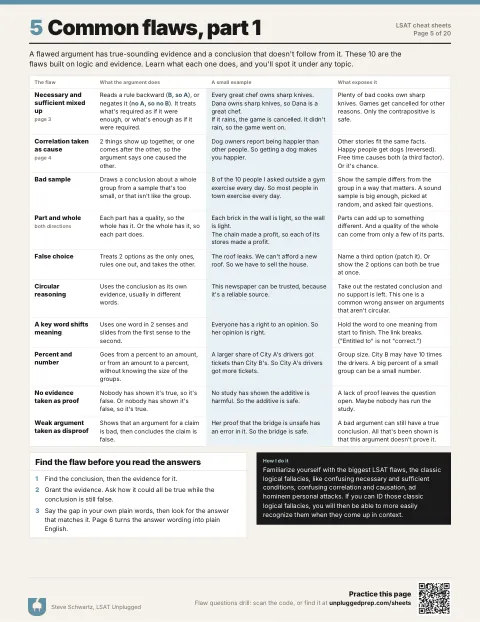
The rebuild produces two lines, and the gap lives between them. The fastest way I know to find it is a question I asked Nina in her first session, on an assumption question:
“Do you see anything new in the conclusion that wasn’t in the evidence?”
She found it. A term in the conclusion that the evidence had never mentioned. That term is the gap, every time, on every assumption question, because the only way a conclusion can contain something the evidence didn’t is if the arguer assumed a bridge. Kevin wrote this into a rule in his second session, after I’d put it this way:
“With necessary assumption, a lot of them, there’s this new claim in the conclusion that did not appear in the evidence. And so its presence in the conclusion has to be justified.”
Two lines, then a comparison: what’s in line two that isn’t in line one. That’s the rebuild doing the work the why-chain will finish.
The third line: point to the text
The rebuild’s third line is the question I ask more than almost any other. If I could put one sentence on a card and hand it to every student at the first session, it would be this: the burden of proof is on the answer choice. A choice doesn’t get to be right because it feels right or sounds like the passage. It doesn’t win because the other four look worse, either. It has to be supported by specific words on the page, and you have to be able to find them.
In the room, that card is a question.
“Can you point to the lines supporting that choice?”
In Reading Comprehension it’s “where in the passage.” In Logical Reasoning it’s “where in the stimulus” (the stimulus is the short paragraph the question is about). Either way, the student goes back to the text, and inside fifteen seconds one of two things happens. They find words, or they don’t. That’s the whole method, running.
The question that became their rule
Eli was a repeat test-taker whose practice scores had been stuck in the mid-150s. His timed Reading Comprehension was ten to twelve right out of a section; untimed, re-reviewing the same section, he’d get eighteen to twenty-two. That gap ruled out understanding as the problem and pointed at what he did under pressure, and a lot of what he did under pressure was pick choices that sounded right.
In our fifth session we were on a question that asks which of several questions the passage helps to answer. He’d picked a choice, he admitted, mostly because he hadn’t understood what it was asking. So we tested it.
“So is the passage answering that question?”
He wasn’t sure. So I asked the real version.
“So I would ask you then, can you point to the lines supporting that choice?”
He read for a while and came back empty. The passage never addresses it. His choice was wrong because there were no words on the page for it, and he’d never gone to look.
We moved to the next tempting choice, and I asked the same thing.
“And so is there a line that supports that choice?”
This time he found something. Most of the choice was supported by a sentence he could point to. One comparison word in the choice wasn’t, and he stalled on it. Good. That one word was where the choice lived or died. Everything else in it was bait. By the end of the exchange he said the rule back to me in his own words, and it was better than my version: go through the choices one at a time, and for each one, ask whether the passage supports it.
I added two things, because he’d earned them. First, you don’t have to go in order.
“You don’t want to just go A, B, C, D, E every single time. If you think C and E are most likely, then of course I would start by evaluating those.”
Second, a choice you don’t understand is not a choice you get to skip.
“Don’t eliminate a choice from consideration just because you don’t know what it means. You still have to consider it and then see if you can eliminate the others.”
That second rule matters more than it looks. Under time, students cross off a choice they don’t understand the same way they cross off a choice they know is wrong, same pen stroke, different reason. In my experience the right answer is often the one hiding inside the awkward sentence.
One word
The smallest version of this may be the most useful.
Theo, first session, a Reading Comprehension question asking what a particular person in the passage believes. The student had been working from what he inferred the author must think, rather than what the passage says the person thinks. I sent him back.
“Where in the passage do we have that suggestion about her thoughts?”
He went to the text, found the sentence, and read it again. I pointed at one word. The passage says a certain thing will happen. His choice said it should. One word. The test writers swap those two on purpose, and the swap costs a point.
“Well, it’s saying they will, not that they should.”
He told me, unprompted, that he should have checked whether the opinion was actually stated instead of working from his own reading. That sentence is a student writing their own rule (that’s chapter 8), and it happened because going back to the text had put the gap in front of him.
The LSAT is on screen now, and questions refer to highlighted text, not line numbers. So I don’t ask students to cite a line number; I ask them to point to the words. On the test’s screen, that’s close to literal. If your finger has nowhere to go, the choice is unsupported. I told Maya this in her first session, when she was leaning on shortcuts she’d picked up from a class:
“You should always be able to find evidence for the choice that you’re picking. And there should always be a specific line that you can point to.”
She’d been taught to look for shift words and topic sentences, and she was good at it, and her score wasn’t moving. In my experience, those tricks will get you to a 155. At 170 everybody has them, so they stop separating anyone. What separates a 170 is whether you can put your finger on the support for every answer you commit to. Not most. Every.
Where are they saying that it should be primary?
Hannah, sixth session, an inference question. She’d explained why one choice felt better and was ready to commit. The choice said a certain kind of evidence should be the primary kind. I asked about one word.
“Now, where are they saying that it should be primary?”
She looked, and admitted it: the passage supported the main claim in the choice and said nothing about primary. The support covered most of the choice and ran out one word before the end.
“So even if they said, you know, we remove the word primarily, what was wrong with this answer? Does that make sense?”
Nothing, without that word. The choice died on one adverb. In my experience a true thing with a strength word bolted on is the most common way an inference choice goes wrong on this test. “Primary,” “only,” “most,” “always,” “never.” The student who points to the text finds support for the true thing and nothing for the bolt. The student who reads for the gist finds the true thing, feels good, and clicks.
Is there a hypothesis?
Some words in a choice are claims about the text, and the test counts on you not checking them. Eli, sixth session, a question about how a passage is organized. He’d picked the choice that said a hypothesis was presented, because the authors described a background belief that sounded like one.
“If you think that’s the case, I would ask you, can you find the lines where they present a hypothesis? Do you see an area where they’re saying, we think this is going to be the result?”
He looked. The authors had a belief the study was testing. Nobody had predicted an outcome.
“A hypothesis means we think that if you do this, this will happen. There’s an expectation outlined: we believe this will be the result.”
With no expectation there’s no hypothesis, and no support for the choice. Words like “hypothesis,” “concedes,” “refutes,” “qualifies,” and “proposes” in an organization or structure choice are factual claims about what the passage does. You can check every one by going to the lines and asking whether the passage does that thing. Students read them as flavor, and they’re the whole choice.
What pointing is really about
In my experience “point to the text” is the step most students skip, because it’s slow and a little humiliating. Finding the support takes longer than feeling it, and going to look means admitting you didn’t already know.
The humiliation is the point. These students didn’t learn the rule because I stated it. Eli had heard “the burden of proof is on the choice” before. He learned it because he went looking for lines that weren’t there, twice, in front of another person, and the discomfort of coming back empty-handed did what no explanation could. Three weeks later he was doing it on his own, and his first score in the 160s came a month after that.
The test writers count on that discomfort being skipped. A wrong choice is written to feel supported, and a right one to feel unsupported. If your test for a choice is how supported it feels, the test writers are grading your paper, and they wrote the choices. Pointing to the text is the one test they can’t rig. I tell students:
“The people who make the LSAT aren’t dumb. They are extremely clever at creating tempting traps in the answer choices. They’re good at making the wrong answer seem appealing, and they’re great at making the right answer seem unappealing. And so when you are engaging in the Socratic Review Method, you want to look at not just why the right answer is right and why the wrong answer is wrong, but you also want to look at what made the right answer choice unappealing to you at first glance and what ultimately makes it correct. And for the wrong answer, you don’t just want to look at what makes it wrong. You also want to look at what about it appealed to you at first, and then upon reflection, what makes it wrong. In other words, you want to look at what were the traps that you personally were prone to falling for.”
What appealed to you at first is a question about you. Eli, Theo, and Hannah answered it every time they went looking for lines and came back with nothing.
Why I ask it this way
I could explain the structure of any argument on the test in about a minute. I don’t. The students in this chapter didn’t need to know the structure of one argument. They needed to be able to find it, under time, on arguments they’d never seen. The only way to build that is to make them do it, badly at first, while I ask the same two questions and refuse to answer them.
When a student can’t do it at all, the session has found the real problem. Someone who can’t tell evidence from conclusion is going to miss assumption questions, flaw questions, strengthen and weaken questions, and every main-point question in Reading Comprehension, and no amount of question-type strategy will touch it. I told Maya this in her sixth session, when she was spiraling about which question types to drill:
“You will not lose anything by analyzing LR stimuli deeply. There’s probably nothing better that you could be doing with your time than to dissect and thoroughly understand these stimuli with their methods of reasoning. As you know by now, it’s not really about the question stem. It’s about the stimulus.”
And here’s the standard I use for whether the rebuild is done:
“Most people think they’re learning when they read a prep book or they watch a video, but that’s not really learning. That’s passive absorption or exposure. Learning means you can explain the idea in your own words and apply it on a real question.”
Two lines, evidence and conclusion. If you can write them, you can see the gap, and the gap is where most of the points on this section live.
The fake version
Here the fake is a tidy summary of the argument, copied from the explanation after you’ve seen the key. It’s a true sentence about the question, a cousin of the Receipt. It proves you can read somebody else’s rebuild, and the test will never hand you one.
In your notebook
Write the two lines. Then draw a box around any word in the conclusion that doesn’t appear, in some form, in the evidence. That box is where the assumption, the flaw, the strengthener, and the weakener all live. If there’s no box, read again: either the conclusion restates the evidence (rare, and the question will be about something else) or you’ve missed a shift in strength or quantity, which chapter 5 is about.
If two lines feel like too much, start smaller. For students who freeze at “what’s the conclusion,” I suggest this:
“I want to encourage you to simply rewrite an entire logical reasoning stimulus in your own words. Break it down as simply as possible. You don’t need to get it right. You don’t even need to get it perfect. I want to give you the freedom to do a bad job now so that you can iterate on that and you can do a slightly better job next time”
Rewrite the whole stimulus badly, in plain words, then find the conclusion inside your own version. Claim and support are easier to pull apart in sentences you wrote than in sentences LSAC wrote. For Reading Comprehension, do it one paragraph at a time.
Then name what made the stimulus hard:
“If it was in the stimulus, paraphrase the stimulus. Put it in your own words and look specifically for what made the stimulus so difficult for you. Where was your misunderstanding? Was it finding the conclusion, the premises, filler, counter-premise, sub-conclusion?”
That last list is the one Marcus ran out loud, sentence by sentence.
Then the third line. For every choice you kept alive, copy the exact words from the text that support it, not the whole paragraph. If the words cover most of the choice but miss one piece, circle the piece. No words at all means you picked it because it felt least wrong, which is a guess with extra confidence.
After a week, look at the circles. Hannah’s circle would have been one adverb. Eli’s would have been empty, more than once. Those are different habits (chapter 7 calls them skeletons, because they keep coming back in new costumes), and a week of pages shows you which one is yours.
Your three questions, step 2
Under each of the three depositions, write the rebuild. Evidence and conclusion in your words, then the words from the text behind every choice you kept alive.
Do all three before you read any explanation. Then box any word in the conclusion that the evidence never mentioned, and circle any piece of a kept choice that has no words behind it. If one of the three wouldn’t come apart into evidence and conclusion at all, write that down. That’s the problem the start of this chapter promised, and it’s the most useful line on the page.